
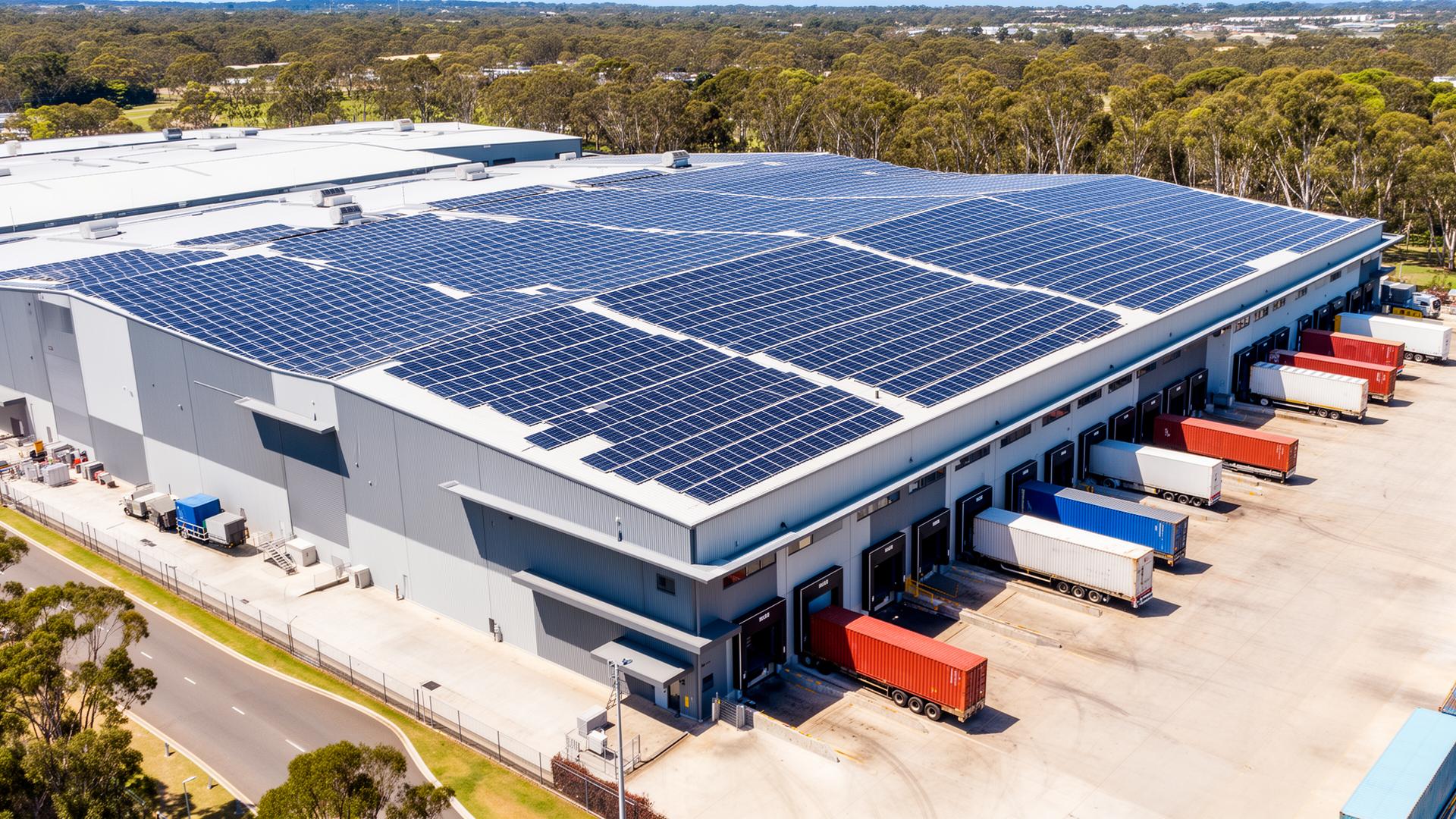
Solar for Brisbane Warehouses & Logistics
Cut your warehouse's $80k–$650k power bill by 50–75% with a 100–500kW rooftop solar (+ optional cold-chain battery). 3–4.5 year payback after STCs, LGCs and IAWO — plus Scope 2 reporting, EV charging integration and outage-proof refrigeration.
★ 4.9 / 42 commercial installs · Cold-chain UPS specialists · Goodman / Dexus / Charter Hall ready
Where warehouse power bills actually go
Refrigeration, MHE charging and high-bay lighting dominate Brisbane DC bills — and all three run almost exclusively on daytime power. That makes warehouses one of the most predictable, fastest-payback solar applications in the commercial sector.
Refrigeration & cold storage
Chilled and frozen DC racks, blast freezers, refrigerated loading docks. Cold storage runs 24/7 at 80–300 kW continuous depending on volume — solar covers daytime, battery storage protects cold-chain integrity through grid outages (a single 4-hour outage on a 1,500-pallet freezer can write off $250k+ of product).
Electric forklift & MHE charging
Modern lithium-ion forklift fleets charge opportunistically — perfectly matched to solar generation. A 20-forklift DC consumes 80–140 MWh/yr just on MHE charging. Smart chargers can be load-shifted to peak solar windows automatically, lifting self-consumption to 85%+.
Lighting, HVAC, dock equipment
High-bay LED lighting (typically 30–80 kW across a large shed), HVAC for office and pick-pack mezzanines, automated conveyor and sortation systems, dock levellers and air curtains. All daytime loads — straight solar offset with no scheduling required.
EV truck & van charging (rapid growth)
Electric delivery vans, last-mile rigid trucks and the first wave of electric prime movers (Volvo FM, Daimler eActros) charging on-site. A medium-duty EV truck consumes 200–400 kWh/day. Solar + battery hubs at the depot are now standard infrastructure for 2026–2030 fleet electrification plans.
Why Brisbane logistics operators are going solar in 2026
Four reasons DC managers, ops directors and CFOs across South-East Queensland are signing solar contracts this year — beyond simple bill savings.
50–75% power bill reduction
A typical Brisbane warehouse with refrigerated dock drops from $210k/yr to $70–100k/yr on a well-sized 250kW solar + 100kWh BESS. Pure ambient sheds without cold storage can hit 75–80% reduction because their load profile is even more daytime-skewed. Five years of compounded savings often exceeds the install cost.
Instant Asset Write-Off + LGCs
Businesses under $50M turnover deduct 100% of install cost in year of purchase under IAWO. Systems over 100kW are LGC-accredited — generating tradeable Large-scale Generation Certificates worth $8–15/MWh on top of bill savings ($12k–$40k/yr extra income on a 250kW system). STCs apply on the first 100kW slice; LGCs apply to ongoing generation.
Cold-chain insurance via battery backup
A single 4-hour blackout on a frozen DC can spoil $100k–$500k of product, breach customer SLAs and trigger insurance excesses. A 100–300 kWh BESS configured as critical-load UPS keeps refrigeration online seamlessly through Energex outages. The avoided-product-loss case alone often justifies the battery, independent of energy arbitrage.
ESG, Scope 2 emissions & 3PL contract wins
Major retailers (Woolworths, Coles, IKEA, Amazon) and freight customers (Toll, DHL, Linfox) now require Scope 2 disclosure and on-site renewable percentage from 3PL partners. A 250kW+ on-site solar install with monitoring dashboard is increasingly a tender-qualifying requirement — not just a nice-to-have. We provide the export data your sustainability team needs for CDP, GRI and CBAM reporting.
Real example: 8,000 m² Brisbane DC with refrigerated dock (TradeCoast)
Real 8,000 m² Australia TradeCoast DC — 250kW rooftop solar across main shed + canopy, 100kWh BESS configured as cold-chain UPS, smart-charging integration for 18 electric forklifts, full Scope 2 reporting export to head office sustainability team.
Grid-only, no on-site generation
- Refrigerated dock + chilled racks (24/7)$92,400/yr
- High-bay LED, HVAC, pick-pack mezzanine$48,600/yr
- MHE charging (18 × electric forklifts)$38,800/yr
- Conveyors, sortation, dock equipment$22,200/yr
- Office, EV van charging, misc$8,000/yr
- Total annual power bill$210,000/yr
250kW solar + 100kWh cold-chain BESS
- 250kW rooftop solar + 100kWh BESS—
- Self-consumed solar + battery cycling362,000 kWh
- Reduced grid imports$78,400/yr
- LGC revenue (250kW @ ~$12/MWh)-$4,300/yr
- Solar export FiT (capped)-$2,100/yr
- Net annual power bill$72,000/yr
Warehouse-sized packages
All proposals include structural roof study, Energex embedded generation application, IAWO documentation, Scope 2 reporting setup and 12-month performance guarantee. Capital, PPA and lease modelled side-by-side.
100kW Light Industrial
- Suits ambient sheds, light-industrial units
- Sungrow / SMA commercial inverter
- Full STC rebate at purchase
- Energex embedded gen approval included
- Real-time monitoring dashboard
- 10-yr workmanship warranty
250kW + 100kWh Standard DC
- Suits 5,000–10,000 m² distribution centres
- Cold-chain UPS configuration
- MHE smart-charging integration
- LGC accreditation + aggregator setup
- Federal commercial battery incentive applied
- Scope 2 reporting export (CDP/GRI/CBAM)
- Switchboard + protection upgrades included
500kW+ Large DC / 3PL Campus
- Suits 15,000 m²+ facilities, multi-tenant estates
- 300–800 kWh BESS for peak shaving
- EV truck charging hub design
- Full Energex/Powerlink connection studies
- Multi-site portfolio pricing
- PPA / capital / hybrid funding modelled
Don't skip the Energex embedded generation study — it sets the financial case
The single most expensive warehouse solar mistake is committing to a 300–500 kW system before Energex confirms export approval on your local feeder. A zero-export outcome can cut financial returns by 15–25% if the design didn't plan for it. Insist that any installer (1) lodges the embedded gen application BEFORE signing your contract, (2) models capital returns under full-export, partial-export and zero-export scenarios, and (3) sizes the system for self-consumption first, export second. Anyone quoting a hard payback number without this is guessing.
Frequently asked questions
DC manager, 3PL operations director and industrial landlord questions, answered.
Turn your roof into your cheapest energy contract.
Free warehouse feasibility within 5 business days. Capital, PPA and lease options modelled. Structural roof study, Energex application, cold-chain UPS design and Scope 2 reporting all included. Brisbane-wide — TradeCoast, Acacia Ridge, Wacol, Crestmead, Yatala, Carole Park, Berrinba.