
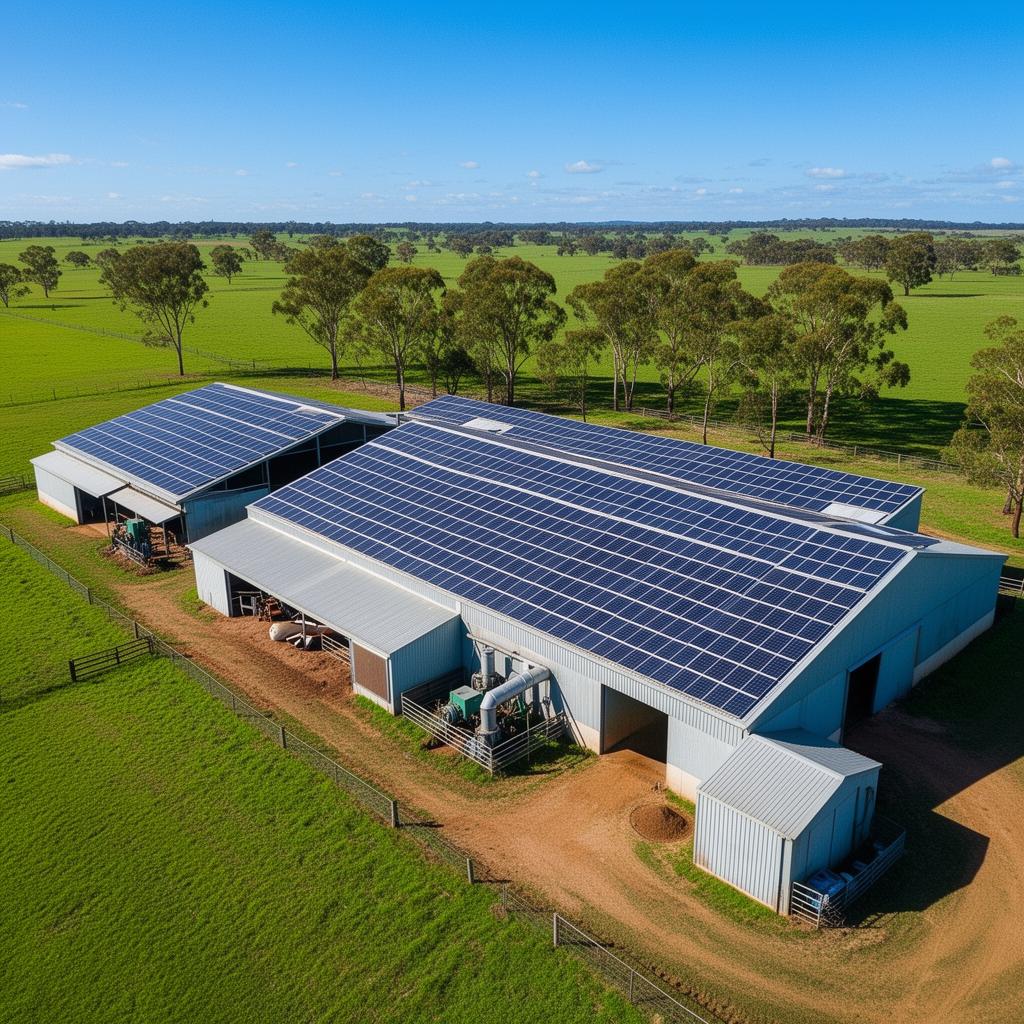
Solar for Queensland Farms & Agriculture
Cut your farm's $25k–$280k power bill by 60–80% with a 30–200kW solar (+ optional battery). 3.5–5 year payback after STCs, IAWO and diesel-pump replacement — plus tariff optimisation, cold-chain backup and a future-ready electric-ag fleet.
★ 4.9 / 38 farm installs · Pump scheduling integration · Cyclone-rated mounting available
Where farm power bills actually go
Irrigation and dairy/packing are the dominant loads on most QLD farms — and they run almost exclusively during daylight hours. That makes farms one of the highest-ROI solar applications in the country.
Irrigation pumps (centre pivots, drip, flood)
Centre pivot pumps (15–75 kW per pivot), drip irrigation booster pumps, bore pumps, flood-irrigation lift pumps. Pump scheduling is the easiest energy win on a farm — run between 10am and 3pm on solar and you essentially eliminate pumping cost. Variable-speed drives (VSDs) on existing pumps amplify the saving.
Dairy shed, packing shed, processing
Vacuum pumps, milk chillers, hot water for dairy wash-down (huge load — 6,000–18,000L hot water per day on a 300-cow farm). Packing line conveyors, graders, washers and pre-coolers on horticulture. All daytime operations — solar covers the lot.
Cold rooms, freezers, controlled-atmosphere storage
Post-harvest cold rooms (10–80 kW continuous depending on volume), blast freezers, controlled-atmosphere apple/avocado storage. Mostly continuous load — solar covers the daytime portion, battery handles overnight. Cold-chain protection is also a strong case for battery backup during storm-season outages.
Sheds, workshops, EV ag equipment
Workshop lighting, welders, compressors, hydraulic test rigs. Increasing fleet of battery-electric ATVs, small tractors, mowers and forklifts — perfectly matched to solar charging. Future-proofing for diesel-to-electric transition (still 5–10 years out for large tractors, but immediate for utility vehicles).
Why QLD farmers are installing solar in 2026
Four reasons primary producers across Queensland are accelerating solar projects — beyond simple bill savings.
60–80% farm power bill cut
A typical QLD horticulture or dairy farm drops from $92k/yr to $20–32k/yr on a well-sized 100kW system. Large operations (broadacre irrigators, intensive horticulture) commonly save $150k–$400k/yr on 200–500 kW installs. For irrigation-dominated farms, savings on diesel-pump replacement add another $40k–$120k/yr.
Instant Asset Write-Off + accelerated depreciation
Primary producers can deduct 100% of solar install cost in the year of purchase under the Instant Asset Write-Off (for businesses under $50M turnover in 2026), or use accelerated depreciation under primary producer rules. Combined with STCs (deducted at purchase up to 100kW) and LGCs (annual revenue stream over 100kW), the after-tax payback drops to 3–4 years on most farms.
Solar diesel-pump replacement
Off-grid irrigation pumps running on diesel cost $0.55–$0.85 per kWh-equivalent. Replacing with a solar+battery direct-drive pump or solar+grid hybrid drops marginal cost to near zero. Diesel-pump replacement typically pays back in 2.5–3.5 years on its own. We design the conversion with your existing irrigation engineer.
Farm Management Deposit (FMD) integration
Solar capex is a planned, predictable expense that pairs neatly with FMD withdrawals — a tax-efficient way to deploy stored income against a long-life productive asset. Your accountant can model the timing, but the combination of FMD withdrawal + IAWO + STCs/LGCs is often the lowest-effective-cost path to solar for established family farms.
Real example: 320-cow Lockyer Valley dairy farm
Real 320-cow Lockyer Valley dairy — 100kW rooftop across dairy + machinery sheds, 40kWh BESS for cold room overnight protection, heat pump replaced LPG for dairy wash-down hot water, pump scheduling automated to solar hours.
Grid + LPG, manual pump scheduling
- Dairy shed (vacuum, chillers, wash-down HW)$38,600/yr
- Centre pivot + bore pumps (2 × pivots)$32,200/yr
- Cold room, workshop, sheds$12,400/yr
- Farm house, fences, lighting, misc$8,800/yr
- Total annual farm power bill$92,000/yr
100kW solar + 40 kWh BESS + heat pump HW
- 100kW rooftop solar (sheds) + 40 kWh BESS—
- Self-consumed solar + battery cycling138,400 kWh
- Reduced grid imports (pumps scheduled to solar)$42,800/yr
- Heat pump dairy hot water (replaced LPG)$11,200/yr
- Solar export FiT-$1,800/yr
- Net annual farm power bill$36,200/yr
Farm-sized packages
All proposals include pump scheduling automation, tariff optimisation analysis, IAWO documentation and 12-month performance guarantee. Capital or PPA modelled side-by-side.
30kW Small Farm / Lifestyle Block
- Suits hobby farms, small horticulture
- Sungrow SG30CX commercial inverter
- STC rebate applied at purchase
- Bore pump scheduling integration
- Off-grid expandable design
- 10-yr workmanship warranty
100kW + 40kWh Standard Farm
- Suits dairy, horticulture, irrigation farms
- Pump scheduling automation
- Cold-room battery backup option
- Federal commercial battery incentive applied
- LGC accreditation (for >100kW configs)
- Ergon Tariff 65/66 optimisation
- Rural switchboard upgrades included
250kW+ Broadacre / Intensive Horticulture
- Suits broadacre irrigators, packing sheds
- 100–300 kWh BESS for night-time cold chain
- Diesel-pump replacement modelled
- Full DNSP/Ergon embedded gen approval
- Multi-site portfolio pricing
- Microgrid-ready architecture
Don't pay for solar capacity you can't actually use without scheduling
The single most common rural solar mistake is oversizing the panel array without changing how pumps and cold rooms are scheduled. A 200kW system on a farm still running pumps at 3am exports 60–70% of generation at 4c/kWh — appalling ROI. Insist that your installer quotes pump scheduling automation as a non-negotiable line item, and that the proposal shows projected self-consumption ratio (target 65%+ for farms without battery, 85%+ with battery).
Frequently asked questions
Primary producer, farm manager and rural accountant questions, answered.
Pump on sunshine. Cut diesel. Bank the savings.
Free farm feasibility within 5 business days. Capital, PPA and FMD-funded options modelled. Pump scheduling, tariff switch and IAWO documentation included. Queensland-wide — Lockyer Valley, Granite Belt, Bundaberg, Mackay, Burnett, Darling Downs.