
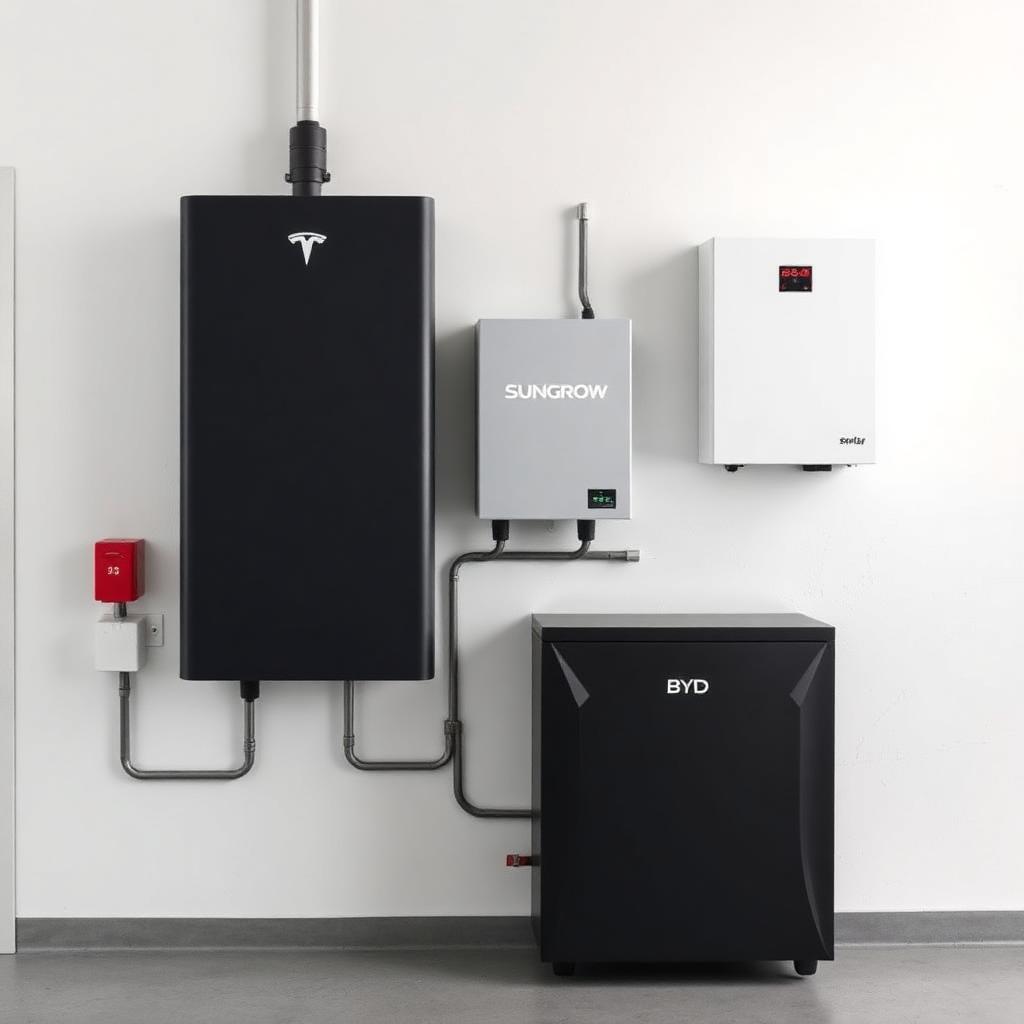
Best Home Battery Australia 2026
Tesla Powerwall 3 vs Sungrow SBH vs BYD HVS vs sonnenBatterie. Capacity, price, warranty, blackout backup — ranked by what actually matters in an Australian home.
We install all 5 brands · Brand-agnostic advice · No commission steering
The 2026 ranking
Five batteries we'd actually quote on a customer's home in 2026, ranked by total value over a 10-year lifecycle — not just sticker price.
Tesla Powerwall 3
The benchmark in 2026. Built-in solar inverter, whole-home backup capable, app is the best in market, and Tesla's RMA network is the largest in Australia. Premium price, but lowest total cost of ownership over 10 years.
- Built-in 11.5kW inverter
- Whole-home backup standard
- Best monitoring app
- Largest service network
- Premium pricing
- Single-unit only up to 13.5 kWh
Sungrow SBH (200/250/300/400)
The smart-money pick for new solar + battery installs. Modular (stack 3.2 kWh shelves), works with Sungrow's market-leading hybrid inverter, and undercuts Tesla by 15–20% installed. Backup needs a Sungrow backup box (add $1,500).
- Modular 9.6–25.6 kWh
- Best $/kWh in tier-1
- Pairs with Sungrow's #1 hybrid inverter
- Stackable up to 4 units
- Backup is an add-on
- Tied to Sungrow inverter
BYD Battery-Box Premium HVS
Most flexible: works with almost every hybrid inverter on the market, and you can start small (5.1 kWh) and add modules as the budget allows. LFP chemistry. Less polished app than Tesla, but solid hardware.
- Works with most inverters
- Start small, grow later
- Safe LFP chemistry
- European engineering
- No built-in inverter
- App quality varies by inverter brand
sonnenBatterie Evo
German-engineered, 10,000-cycle warranty (vs Tesla's ~3,650), and AC-coupled so it retrofits onto any existing solar system. Expensive, but the longest cycle life on the market and the most thorough monitoring.
- 10,000-cycle warranty
- Retrofits any solar system
- German build quality
- Best for VPP participation
- Most expensive per kWh
- Lower peak power (4.6kW)
GoodWe Lynx Home F G2
Cheapest tier-1 battery on the market in 2026 if paired with a GoodWe hybrid inverter. Quality is good, but the app, service network and resale value lag the top three. Fine for budget-conscious self-consumption builds.
- Cheapest $/kWh tier-1
- Modular 6.6–16.4 kWh
- LFP chemistry
- Smaller AU service network
- Tied to GoodWe inverter
- App lags competition
Six factors that decide your pick
More important than brand loyalty or sticker price — these are the specs that determine whether a battery actually pays back.
Usable kWh, not nominal
Always compare usable capacity (Tesla 13.5, Sungrow stack 9.6–25.6) — not nominal. Some brands quote nominal then derate 10–15% in the fine print.
Continuous power matters for blackouts
If you want to run a ducted A/C during a blackout you need 7kW+ continuous. Tesla Powerwall 3 (11.5kW) and Sungrow + SH10RT (10kW) both clear this bar. sonnenBatterie (4.6kW) cannot.
AC vs DC coupling
DC-coupled (Powerwall 3, Sungrow SBH + hybrid, BYD + hybrid) is 3–5% more efficient and is the right call for new installs. AC-coupled (sonnenBatterie, Tesla via Gateway 3, BYD + AC inverter) is the right call for adding storage to an existing solar system.
Warranty: cycles AND years
Tesla, Sungrow, BYD and GoodWe all warrant 10 years OR a throughput in MWh, whichever comes first. sonnenBatterie warrants 10,000 cycles — about 27 years of daily use — which is the longest in the market.
VPP participation
Joining a Virtual Power Plant (Amber, AGL, Tesla Energy Plan, ShineHub) can earn $500–$1,200/yr extra. Tesla Powerwall 3 and sonnenBatterie have the broadest VPP compatibility; Sungrow/BYD are catching up but check before signing.
Federal battery rebate (2025+)
The federal Cheaper Home Batteries Program (effective 1 July 2025) discounts roughly $330/kWh installed up to 50 kWh. All five brands above qualify. This is on top of any QLD state-level rebates.
Batteries we won't quote
Re-badged Chinese NMC batteries under $600/kWh, brands without an AU-based RMA office, anything where the warranty is fronted by the installer rather than the manufacturer, and Powerwall 2 (discontinued; warranty support winding down). If a quote looks too cheap, the warranty path is usually the catch.
Frequently asked questions
Battery questions Australian homeowners ask before buying.
Get a brand-agnostic battery quote
We install all five top brands. Tell us your roof, your usage and your budget — we'll quote the battery that actually fits, not whichever pays the highest commission.