
Solar for Brisbane Manufacturing & Workshops
Cut your factory's $60k–$580k power bill by 55–75% with a 50–500kW rooftop solar (+ optional peak-shave battery). 3–4.5 year payback after STCs, LGCs and IAWO — plus demand-charge reduction, compressor VSD retrofits and Scope 2 reporting.
★ 4.9 / 47 industrial installs · Peak-shave battery specialists · CBAM / CDP / GRI reporting ready
Where factory power bills actually go
CNC machining, welding/cutting, compressed air and process heat dominate Brisbane factory bills — and almost all of it runs on a single day shift. That makes manufacturing one of the highest self-consumption, fastest-payback solar applications in the commercial sector.
CNC, lathes, mills, press brakes
Modern CNC machining centres draw 15–60 kW continuous during cutting, with spindle inrush peaks of 80–120 kW. Press brakes, turret punches and laser cutters add another 20–80 kW each. Almost all run a single 7am–4pm shift — perfectly aligned with peak solar generation. Self-consumption on machining-led workshops typically hits 80%+ without any load shifting.
Welding bays, plasma & laser cutting
MIG/TIG welders (5–25 kW each), plasma cutters (20–60 kW), fibre laser cutters (40–120 kW + chiller). A 6-bay welding shop with one plasma table easily consumes 200–350 kWh/day, with sharp short-duration peaks that drive demand charges. Solar covers the energy; battery peak-shaving controls the demand charge — the two together typically halve a fabrication shop's bill.
Air compressors & vacuum systems
Workshop air compressors (15–110 kW) are usually the single largest continuous load in a manufacturing facility, running 6–10 hours a day to maintain line pressure. Variable-speed compressors paired with solar deliver compounding savings — VSD alone cuts 25–40% of compressor energy, then solar covers the remainder during daylight. Compressed-air leak audits paired with solar installs typically find another 15% saving for free.
Powder coating, ovens, paint booths
Powder-coat ovens (40–150 kW electric, or gas with electric fans/cure), wet paint booths with extract fans and heated curing, blast cabinets. Electric ovens are the highest-ROI conversion target — replacing a gas cure oven with a heat-pump or resistive electric oven and running it on solar can eliminate 80% of cure-cycle energy cost. Increasingly used for ESG-tender qualification (zero-emissions finish).
Why Brisbane manufacturers are going solar in 2026
Four reasons production managers, plant engineers and operations directors across South-East Queensland are signing solar contracts this year — beyond simple bill savings.
55–75% factory bill reduction
A typical Brisbane mid-size fabrication shop drops from $165k/yr to $50–75k/yr on a well-sized 150kW solar + 80kWh BESS. Larger manufacturers (food processing, plastics extrusion, metal finishing) routinely save $250–550k/yr on 300–500kW installs. The compounding effect over 5 years usually exceeds the install cost — and unlike raw-material or labour costs, energy savings are locked in for 25 years.
Demand charge peak shaving via battery
Mid and large manufacturers on Energex demand tariffs pay $15–45/kVA/month on peak demand — often 20–35% of the total bill, independent of energy consumption. A 60–200 kWh BESS configured for demand-charge shaving discharges into peak machining/welding events, capping recorded demand 30–50%. On a $165k bill with $45k of demand charges, that's a $15–22k/yr saving from the battery alone — independent of solar energy savings.
IAWO + STCs + LGCs stacked
Manufacturers under $50M turnover deduct 100% of install cost in year of purchase under IAWO. STCs apply on the first 100kW slice; LGC accreditation on 100kW+ systems generates tradeable certificates worth $8–15/MWh ongoing ($12k–$50k/yr extra income on a 250kW system). Combined with accelerated Div 40 depreciation on the battery, after-tax payback typically lands at 3–4 years.
Scope 2 reporting & tender qualification
Tier-1 buyers (Boeing, BAE, Rio, BHP, Bunnings, Coles supplier panels) increasingly require Scope 2 emissions disclosure and minimum on-site renewable percentages from manufacturing suppliers. A 100kW+ solar install with monitoring dashboard satisfies most current tender requirements — and positions you for CBAM (EU carbon border tariff) impacts on export product from 2026 onwards. We provide reporting exports in CDP, GRI, ISSB and CBAM formats.
Real example: Mid-size Brisbane fabrication shop (Acacia Ridge)
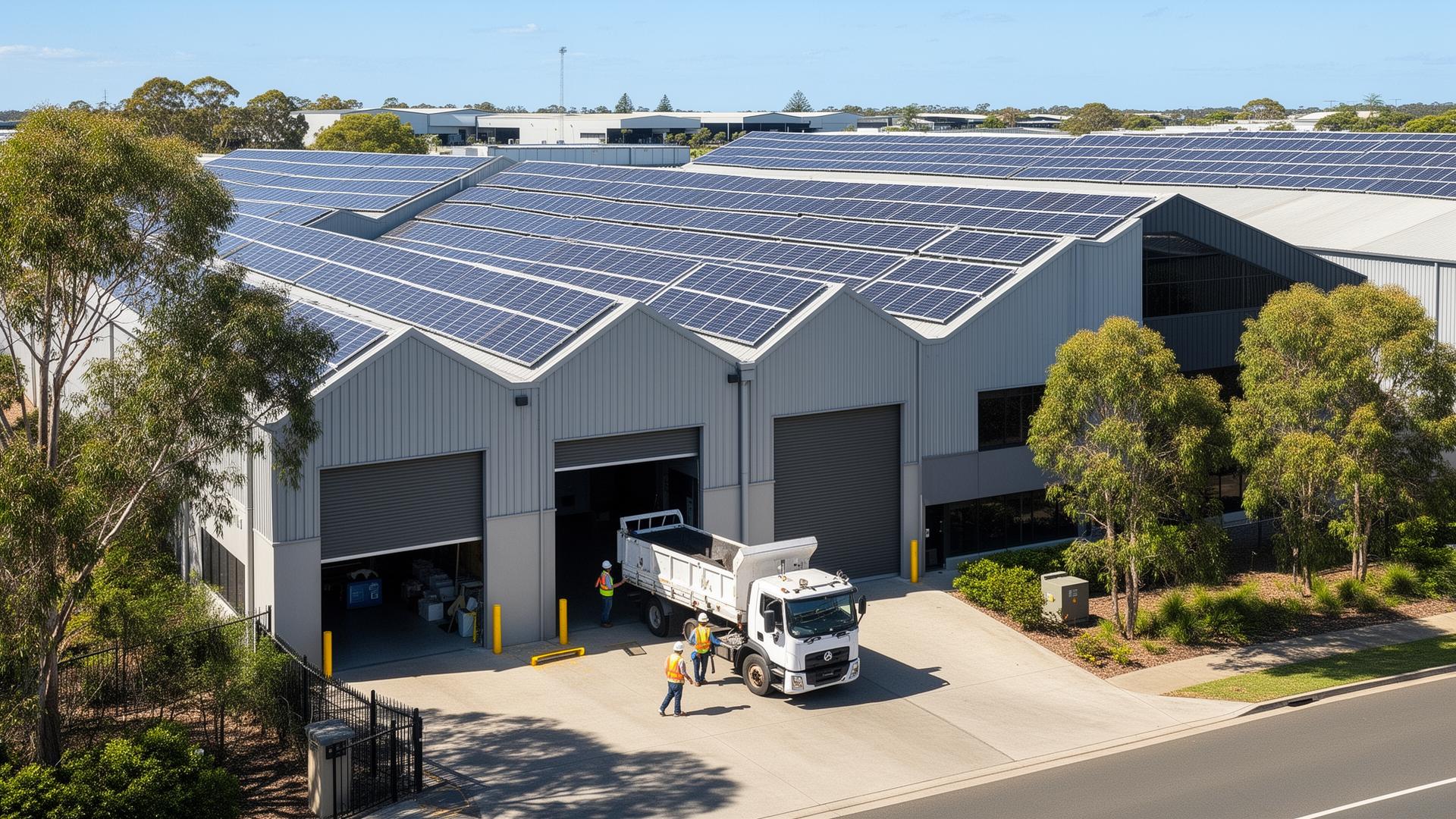
Real Brisbane Acacia Ridge fabrication shop — 3 CNC machines, 6 welding bays, plasma table, 75 kW air compressor, powder-coat line. 150kW rooftop solar across the sawtooth roof, 80kWh BESS configured for demand-charge peak shaving, VSD retrofit on the main compressor.
Grid-only, fixed-speed compressor, no demand mgmt
- CNC mills, lathes, press brake (3 machines)$42,600/yr
- Welding bays + plasma table (6 bays)$31,800/yr
- Air compressor (75 kW, fixed speed)$28,400/yr
- Powder coat line + oven (gas + electric)$24,200/yr
- Demand charges (peak kVA)$22,800/yr
- Lighting, HVAC, office, dispatch$15,200/yr
- Total annual factory bill$165,000/yr
150kW solar + 80kWh peak-shave BESS + VSD compressor
- 150kW rooftop solar + 80kWh peak-shave BESS—
- Self-consumed solar + battery cycling218,000 kWh
- Reduced grid imports$62,400/yr
- Demand-charge reduction (battery shaving)$11,800/yr
- VSD compressor retrofit (paid by Eco Energy)$8,200/yr
- LGC revenue + solar export FiT-$3,400/yr
- Net annual factory bill$56,200/yr
Factory-sized packages
All proposals include structural roof study, Energex embedded generation application, IAWO documentation, demand-charge analysis and 12-month performance guarantee. Capital, PPA and lease modelled side-by-side.
50kW Small Workshop
- Suits trade workshops, small fabricators
- Sungrow / SMA commercial inverter
- Full STC rebate at purchase
- Compressor + welder demand analysis
- Energex embedded gen approval included
- 10-yr workmanship warranty
150kW + 80kWh Standard Factory
- Suits 1,500–4,000 m² manufacturing sheds
- Demand-charge peak shaving configured
- VSD compressor retrofit costed
- LGC accreditation + aggregator setup
- Federal commercial battery incentive applied
- Scope 2 reporting export (CDP / GRI / CBAM)
- Switchboard + power-factor correction included
300kW+ Large Manufacturer
- Suits 5,000 m²+ factories, food processors
- 200–500 kWh BESS for major peak shave
- Process heat electrification modelled
- Full Energex/Powerlink connection studies
- Multi-site portfolio pricing
- PPA / capital / lease modelled side-by-side
Don't quote solar without modelling demand charges
The single most common manufacturing solar mistake is sizing PV against consumption only and ignoring demand tariffs. On a typical $165k factory bill, $20–45k of that is demand charges driven by a handful of brief peak events — and naked solar (no battery) does almost nothing to reduce them. Insist that any installer (1) shows your demand-charge component as a separate line on the savings model, (2) models battery peak shaving with realistic discharge curves against your actual interval data, and (3) sizes the battery for demand reduction first, energy arbitrage second. Anyone quoting a hard payback without this is leaving 15–25% of your savings on the table.
Frequently asked questions
Production manager, plant engineer, operations director and CFO questions, answered.
Turn your sawtooth roof into your cheapest input cost.
Free factory feasibility within 5 business days. Capital, PPA and lease modelled. Structural study, Energex application, demand-charge analysis and Scope 2 reporting all included. Brisbane-wide — Acacia Ridge, Wacol, Crestmead, Yatala, Salisbury, Hemmant, Eagle Farm, Carole Park.