
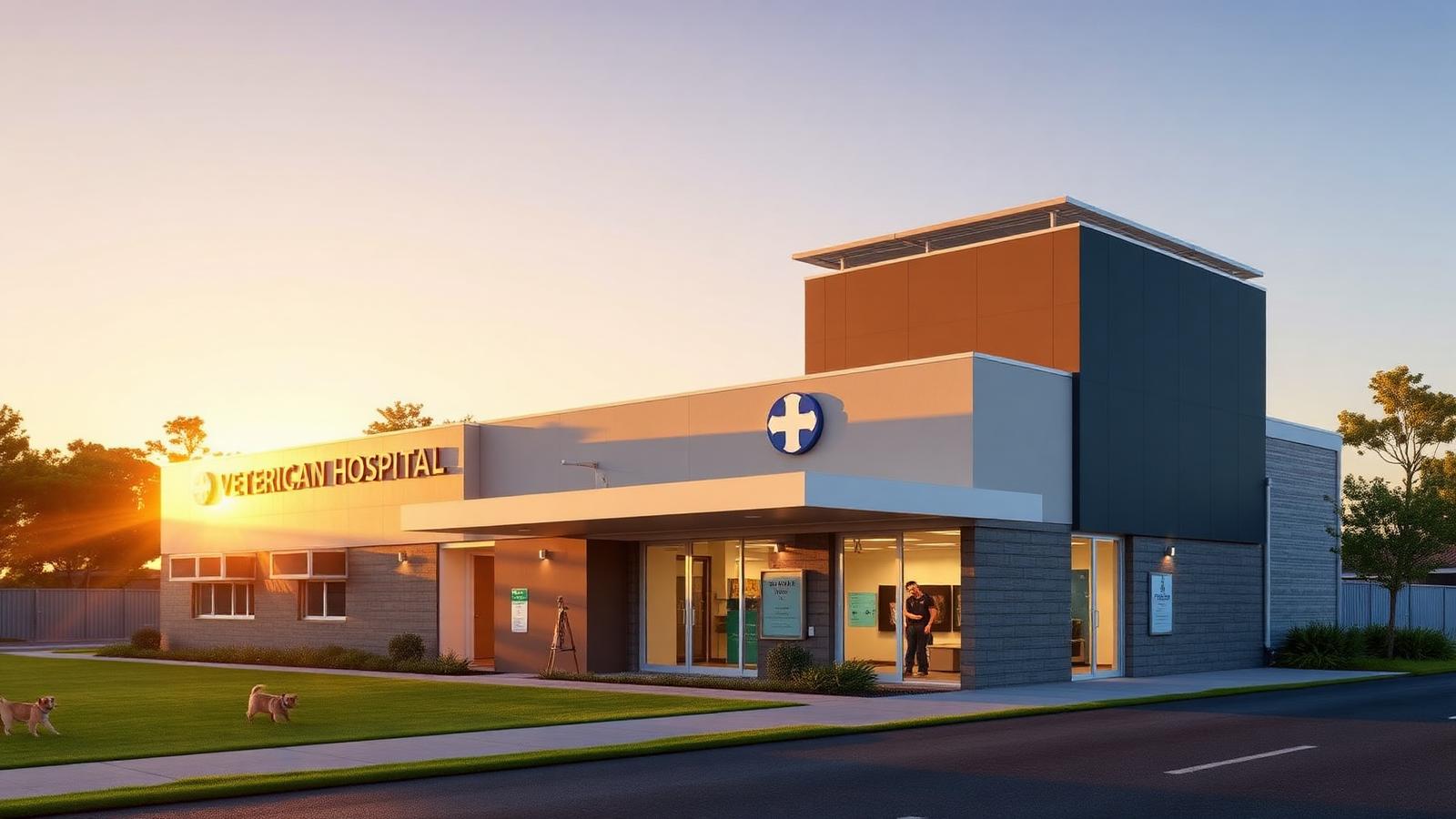
Solar for Brisbane Vet Clinics & Animal Hospitals
Cut your clinic's $28k–$185k power bill by 55–70% with a 15–80kW rooftop solar (+ optional critical-load battery). 3.5–5 year payback after STCs and IAWO — drug-fridge UPS, ICU resilience, corporate group sustainability reporting and zero impact on diagnostic equipment.
★ 4.9 / 26 vet clinic installs · Drug-fridge UPS specialists · Greencross / VetPartners / NVS ready
Where vet clinic power bills actually go
HVAC, surgical, diagnostics, drug fridges and kennel ventilation dominate vet clinic bills — and most of it runs across an extended trading day or 24/7 in the case of emergency hospitals. High self-consumption potential makes vet clinics one of the strongest small-commercial sectors for solar + battery.
Surgical suite, anaesthesia, monitoring
Surgical lighting, anaesthetic machines with active gas scavenging, multi-parameter monitors, surgical diathermy and laser units. Anaesthesia and monitoring run continuously through procedures during the day — solar covers the load completely. Power-quality requirements are high (anaesthesia gas mixing is sensitive), so we always install pure-sine-wave hybrid inverters and recommend a small UPS layer for the surgical suite.
Diagnostics: X-ray, ultrasound, in-house lab
Digital DR/CR X-ray (10–40 kW peak demand during exposure), ultrasound, in-house haematology and biochemistry analysers (IDEXX, Heska, Abaxis), centrifuges. Diagnostic equipment has sharp short-duration peaks that drive demand charges on larger clinics — solar offset plus a small battery handles both energy and demand neatly. Sensitive analysers benefit from the clean power conditioning a hybrid inverter delivers.
Autoclaves, dental, sterilisation, drug fridges
Autoclaves (3–8 kW per cycle, run 4–8 times per day), ultrasonic instrument washers, dental units with compressors, drug refrigerators (vaccines, insulin, controlled drugs at strict 2–8°C). Drug fridge integrity is a regulatory requirement (DEA/APVMA-grade refrigeration with logged temperatures) — battery backup is non-negotiable on serious clinics, and pairs naturally with solar.
Kennels, ICU, boarding & isolation HVAC
Boarding kennels, recovery cages, ICU ward with oxygen cages and patient warming (forced-air warmers, heat lamps, water blankets), isolation ward with dedicated HVAC and HEPA filtration for infectious patients. Kennel and ICU HVAC run 24/7 — significant continuous load that solar covers during the day, battery covers overnight, and which makes vet clinics one of the highest-utilisation small-commercial sectors for solar+storage.
Why Brisbane vet practices are going solar in 2026
Four reasons practice owners, hospital directors and corporate group sustainability teams across South-East Queensland are signing solar contracts this year — beyond simple bill savings.
55–70% clinic power bill reduction
A typical 4-vet Brisbane GP clinic with boarding drops from $68k/yr to $22–28k/yr on a well-sized 25kW solar + 13kWh BESS. Larger emergency/specialist hospitals (24/7 trading, multiple operating theatres, MRI/CT) routinely save $85–160k/yr on 80–150kW installs. Five years of compounded savings nearly always exceeds the install cost — and unlike consult-fee revenue, the savings are locked in for 25 years independent of bookings.
Drug fridge & ICU resilience via battery
A 4-hour blackout on a busy clinic can spoil $8–25k of drugs (vaccines, controlled substances, in-progress lab reagents), trigger reporting obligations to APVMA, and force ICU patient transfers. A 10–40 kWh BESS configured as critical-load UPS keeps drug fridges, ICU oxygen cages, surgical monitoring and in-progress autoclaves online seamlessly. The avoided drug-loss + transfer-cost case alone often justifies the battery on busy clinics — independent of any energy saving.
Corporate group sustainability programs
Major vet corporate groups (Greencross, VetPartners, National Veterinary Care, Vet Partners NZ, Apiam) now operate sustainability programs with on-site renewable percentage as a scored metric for hospital re-investment decisions and tier-1 referral status. Independent clinics aspiring to ASAV/AAHA-style accreditation also score sustainability points. We provide install documentation suitable for all major group sustainability teams and AAHA assessors.
IAWO + STCs + practice depreciation
Vet clinics under $50M turnover deduct 100% of install cost in year of purchase under IAWO. STCs apply at purchase on all systems up to 100kW. Battery storage attracts accelerated Div 40 depreciation. Combined, after-tax payback typically lands at 3–4 years on private GP clinics — and the cashflow uplift in year 1 frequently funds an equipment upgrade (digital dental, ultrasound replacement) that wouldn't otherwise have fitted the budget.
Real example: 4-vet Brisbane GP clinic with boarding (Logan)
Real 4-vet Logan GP clinic — open Mon–Sat 7am–7pm with after-hours triage, 12-cage boarding, surgical suite, in-house lab + digital X-ray. 25kW rooftop solar, 13kWh BESS configured as critical-load UPS protecting drug fridges + surgical monitoring + ICU oxygen cage, heat pump HW replaced gas.
Grid + gas, no critical-load backup
- HVAC (reception, consult, ICU, kennels, isolation)$22,400/yr
- Surgical suite, autoclaves, dental, monitoring$14,800/yr
- Diagnostics (X-ray, ultrasound, in-house lab)$8,600/yr
- Drug fridges, lab fridges, freezer, ice machine$6,400/yr
- Boarding kennels lighting + ventilation (24/7)$9,200/yr
- Reception, admin, hot water, dispatch$6,600/yr
- Total annual clinic bill$68,000/yr
25kW solar + 13kWh critical-load BESS + heat pump HW
- 25kW rooftop solar + 13kWh critical-load BESS—
- Self-consumed solar + battery cycling41,200 kWh
- Reduced grid imports$22,800/yr
- Heat pump hot water (replaced gas)$2,400/yr
- Solar export FiT-$1,100/yr
- Net annual clinic bill$23,700/yr
Clinic-sized packages
All proposals include roof assessment, Energex/grid application, IAWO documentation, critical-load sub-board design and 12-month performance guarantee. Corporate group approval coordination included where applicable.
10kW Single-Vet / Branch
- Suits 1–2 vet branch / mobile clinic base
- Sungrow / Fronius hybrid inverter
- Full STC rebate at purchase
- Drug fridge sub-metering included
- Battery-ready for later add-on
- 10-yr workmanship warranty
25kW + 13kWh Standard Clinic
- Suits 3–6 vet GP clinic with boarding
- Drug fridge / ICU critical-load UPS
- Surgical suite dedicated sub-board
- Federal residential/SMB battery incentive applied
- Heat pump HW replacement modelled
- Energex tariff optimisation
- 10-yr workmanship + 12-month performance guarantee
80kW+ Emergency / Specialist Hospital
- Suits 24/7 emergency, specialist referral, university
- 60–150 kWh BESS for full critical-load backup
- Multi-theatre dedicated sub-boards
- Energex commercial embedded gen approval
- Corporate group sustainability reporting
- Capital / PPA / lease modelled side-by-side
Don't install vet-clinic solar without a critical-load sub-board
The single most common vet clinic solar mistake is installing standard grid-tied solar with no critical-load architecture. APVMA-controlled drug fridges, ICU oxygen cages and in-progress surgical monitoring don't get to wait politely for grid restoration — and a 4–6 hour storm-season blackout can cost $8–25k in dumped drugs plus controlled-substance reporting obligations. Insist your installer (1) designs a dedicated critical-load sub-board, (2) sizes the battery to bridge a worst-case overnight outage of all critical loads, and (3) configures seamless islanding (under 20ms transfer). The incremental cost over basic solar is $8–15k and pays for itself the first time a serious outage hits.
Frequently asked questions
Practice owner, hospital director, head vet and corporate group sustainability team questions, answered.
Protect drug fridges, ICU and your bottom line.
Free clinic feasibility within 5 business days. Critical-load UPS architecture, corporate group approval coordination, IAWO + STC documentation included. Brisbane-wide — Logan, Ipswich, Redlands, Moreton Bay, Sunshine Coast, Gold Coast. GP, ER, specialist and pet cremation operators welcome.