
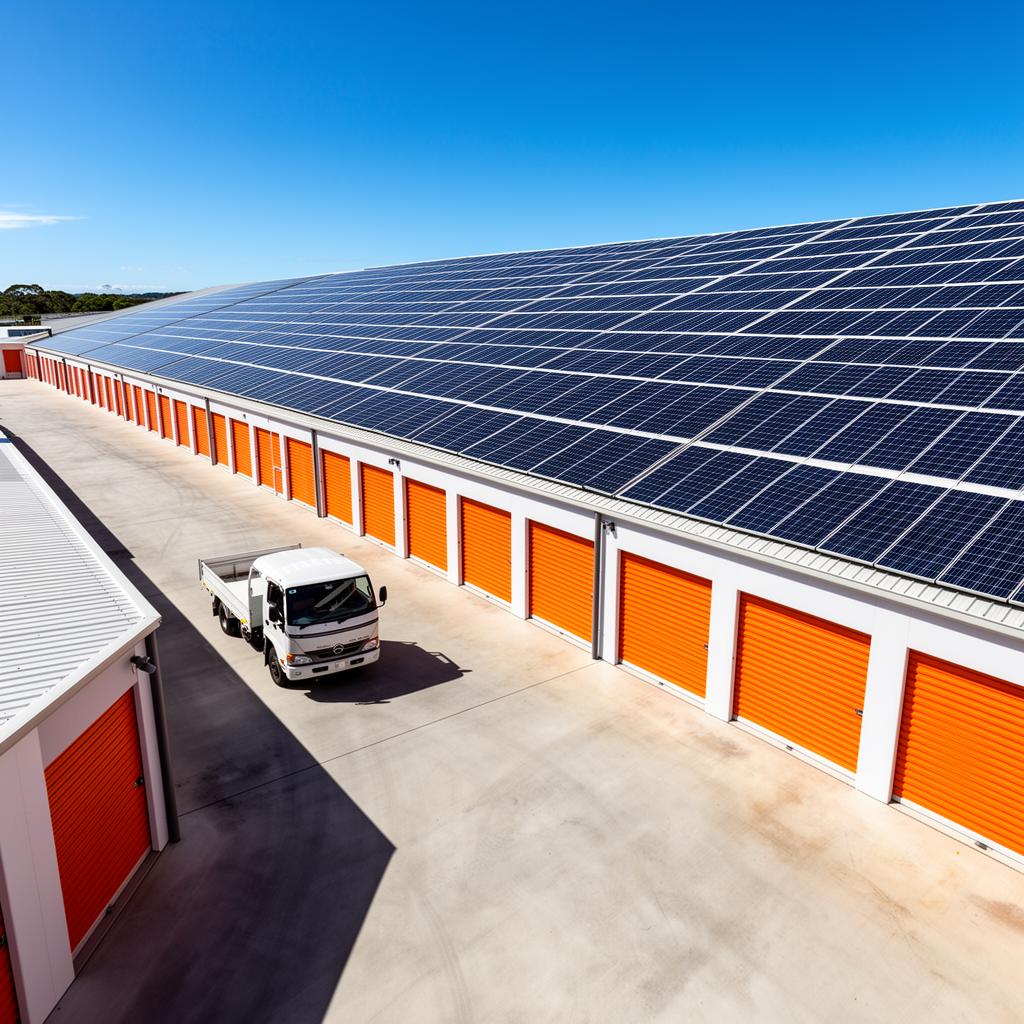
Solar for Brisbane Self-Storage Facilities
Monetise 3,000–15,000m² of empty roof. Three viable models — host-owned (4–5 yr payback), PPA (zero capex) or rooftop lease ($25–60k/yr ground rent). Hedges climate-control margin, funds customer EV charging, and unlocks REIT-grade ESG reporting.
★ 4.9 / 19 self-storage installs · Host / PPA / rooftop-lease modelling · National Storage / KSO / Storage King ready
Where self-storage energy actually goes
Climate-control HVAC dominates on premium-tier sites and runs 24/7. The on-site load is meaningful but typically much smaller than the roof's solar capacity — which is why self-storage is the rare sector where export economics and rooftop-lease models genuinely compete with host-owned.
Climate-controlled units (premium-tier)
Climate-controlled storage is the single fastest-growing product in Australian self-storage — typically 15–30% gross rental premium per m² over standard non-conditioned units. The HVAC load to hold 18–24°C and <55% RH across a Brisbane summer is significant (40–180 kW depending on conditioned floor area), runs 24/7, and aligns reasonably well with the solar curve in the afternoon-peak hours. Solar materially de-risks the climate-control product margin from electricity-tariff exposure.
24/7 security, CCTV, access control & lighting
Facility-wide CCTV (typically 32–96 cameras with NVR storage), site-wide PIR/dusk-to-dawn LED lighting across drive-aisles and corridor units, 24/7 keypad / Bluetooth / mobile-app access control gates and barriers. Security loads run continuously and are essentially the floor of base demand — meaningful but small relative to roof capacity, which is why most storage facilities export most of their generation rather than self-consume.
EV charging amenity for customers & moving trucks
Storage facilities are emerging as a natural daytime EV charging destination — customer dwell times during a move-in/move-out (1–4 hours) are perfect for 22kW AC or 50kW DC charging, and many facilities operate complementary van/ute hire programs that can be electrified. Solar + battery + 2–6 EV chargers turns the storage facility into a destination amenity and an additional small revenue line, all funded by surplus solar that would otherwise export at low FiT.
Office, reception, surveillance room, signage
Manager's office and reception with HVAC and computing, central surveillance room (NVR servers, monitor wall), illuminated pylon and facade signage, retail counter (boxes, locks, packaging supplies). On unmanned/digital-first facilities the office load is minimal — pushing the export ratio even higher and making host-owned solar economics weaker but rooftop-lease economics stronger.
Why Brisbane storage operators are going solar in 2026
Four reasons facility owners, operators, REITs and institutional capital allocators across South-East Queensland are signing solar contracts this year — beyond simple bill savings.
Three distinct revenue models from one roof
Self-storage roofs are unique in commercial solar because three viable models exist: (1) Host-owned — you finance, capture all savings + export + LGC + IAWO, 4–5 yr payback. (2) PPA — financier owns the system, you buy power at 6–8 c/kWh (vs 28–38 c/kWh grid), zero capex, ~$35–80k/yr net cashflow on a mid-size site. (3) Rooftop lease — third-party builds and operates a 500kW–1MW array purely for export to grid or to an adjacent commercial neighbour via embedded network, you receive a $25–60k/yr annual ground-lease payment for 20 years. We model all three side-by-side and recommend based on your capex appetite and ESG positioning.
Hedge climate-control product margin
Climate-controlled storage carries 15–30% premium pricing but the gross margin is highly sensitive to electricity tariff escalation — a 10% tariff rise can compress climate-control margin by 4–7% on a heavily-conditioned facility. Solar at 4–6 c/kWh LCOE (vs 28–38 c/kWh grid) locks in the climate-control cost base for 25 years and converts climate-controlled storage from a tariff-exposed product into a tariff-immune one. Operators expanding the climate-control share of their mix should treat solar as a strategic margin hedge, not a sustainability tick-box.
Listed-REIT and institutional ESG positioning
National Storage REIT, Abacus Storage King, Kennards Self Storage and the institutional capital backing growth-phase operators (Charter Hall, Centuria, ISPT) all now have published Scope 1/2 reduction targets and progress reporting in annual sustainability statements. A 500kW–1MW rooftop solar build moves the needle visibly on facility-level Scope 2 — and the export volume often qualifies the site for inclusion in green-finance debt facilities (CommBank, NAB, Westpac all run green-loan / sustainability-linked-loan products with priced incentives). We provide install documentation in REIT-ready and SLL-compliant format.
IAWO + LGC stack + Div 40 + rooftop ground-rent (if leased)
Self-storage operators under $50M turnover deduct 100% of install cost in year of purchase under IAWO. Systems above 100kW create LGCs annually — typically worth $15–35k/yr on a 500kW system at current spot pricing. Battery storage attracts accelerated Div 40 depreciation. If the rooftop-lease model is selected instead, the ground-rent payment is straight rental income (no install capex, no depreciation, no operational responsibility) — particularly attractive for facilities held in trust or REIT structures where simplicity matters.
Real example: 8,000m² SEQ self-storage facility (Logan corridor)
Real 8,000m² Logan-corridor facility — 3,200m² climate-controlled units, 4,800m² standard, 92 CCTV cameras, 24/7 keypad access, on-site manager office, complementary 4-van hire program. 500kW rooftop solar, 100kWh BESS for export-shaping and EV charging support, 4 × 22kW AC chargers installed for customer use.
Grid only, dead roof asset, no EV amenity
- Climate-control HVAC (3,200m² conditioned units)$78,000/yr
- Security, CCTV, access control (24/7)$14,200/yr
- Drive-aisle + corridor LED lighting$11,800/yr
- Office, reception, signage, hot water$8,400/yr
- Total annual facility bill$112,400/yr
500kW solar + 100kWh BESS + 4 EV chargers
- 500kW rooftop solar + 100kWh BESS—
- Self-consumed solar + battery cycling182,000 kWh
- Reduced grid imports$58,400/yr
- Export revenue (surplus at FiT + LGC)$38,200/yr
- EV charging program net revenue (4 chargers)$11,500/yr
- Net facility position after operating cost-$4,300/yr (net positive)
Three models, one roof
All proposals include roof structural assessment, Energex/grid application, IAWO + STC/LGC documentation, side-by-side host-owned vs PPA vs rooftop-lease cashflow projections, EV-charger sizing and 12-month performance guarantee.
Host-Owned 200kW (Small Facility)
- Suits 3,000–5,000m² facility, partial climate-control
- Sungrow / Fronius / SMA commercial inverter
- Climate-control HVAC sub-board integration
- LGC creation begins year 1
- EV-charger ready (single phase upgrade path)
- 10-yr workmanship + 12-month performance guarantee
Host-Owned 500kW + EV (Standard)
- Suits 6,000–10,000m² facility, full climate-control
- 100 kWh BESS for export shaping + customer EV charging
- 4 × 22kW AC or 2 × 50kW DC EV chargers included
- Annual LGC creation + sale included
- REIT / SLL-ready sustainability reporting
- Energex commercial embedded gen approval
- Capital / PPA / rooftop-lease modelled side-by-side
Rooftop Lease / 1MW+ (Large)
- Suits 12,000m²+ facility or multi-site portfolio
- Zero capex, zero operational responsibility
- 20-year ground lease, indexed annually
- Optional: discounted on-site PPA included
- Embedded network export to adjacent commercial
- Multi-site portfolio rollout coordination
Don't accept a rooftop-lease offer without modelling host-owned and PPA first
Several national rooftop-lease aggregators are aggressively door-knocking SEQ self-storage operators with seemingly attractive $20–40k/yr ground-rent offers on 20-year contracts. These are often financially fine — but they typically capture 60–75% of the lifetime value of your roof for the lessee. Insist your installer (1) models host-owned vs PPA vs rooftop-lease side-by-side, (2) discloses lessee margin assumptions, (3) explicitly assigns LGCs and ESG/Scope 2 reduction rights, and (4) prices a buy-out / removal clause for future redevelopment. The right model depends on your capex appetite and hold horizon — not on whoever knocked first.
Frequently asked questions
Owner-operator, REIT, institutional capital and facility manager questions, answered.
Turn dead roof into income. Hedge climate-control. Add EV.
Free facility assessment within 10 business days — covers roof structural, Energex export limits, all three commercial models and EV-charger feasibility. Brisbane-wide — Logan, Ipswich, Redlands, Moreton Bay, Sunshine Coast, Gold Coast. Owner-operators, REITs, multi-site groups and ground-leased trust assets welcome.