
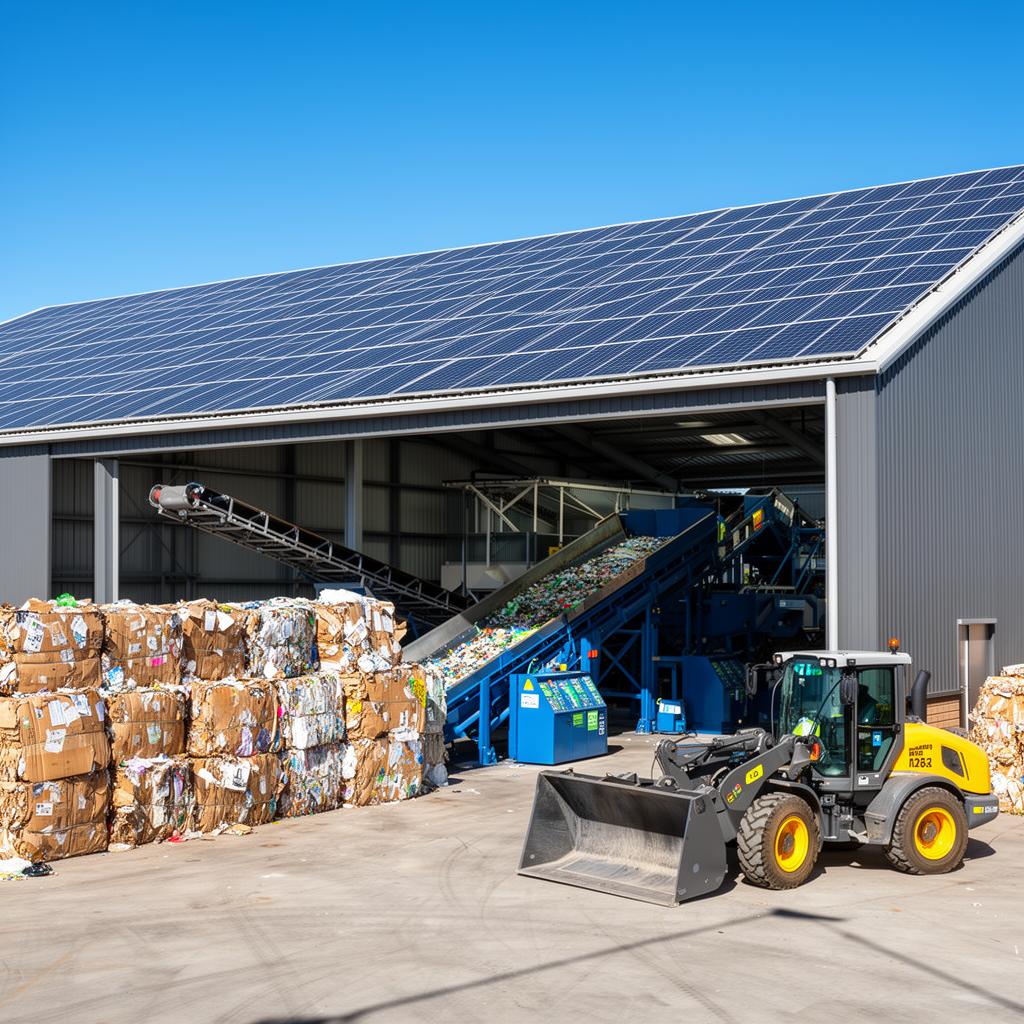
Solar for Brisbane Recycling, MRFs & Waste Transfer Stations
Cut your facility's $85k–$620k power + diesel bill by 55–70% with 100–500kW rooftop solar paired with BESS baler peak-shaving, full LED yard retrofit and electric front-end loader + forklift fleet transition. 3.4–4.8 year payback after STCs, LGCs, IAWO, ARENA, QRRRP grants and electric heavy-vehicle rebates — WMRR + ACOR aligned, LGA kerbside tender Scope 1+2+3 dossier prepared, EPA Queensland regulatory pathway managed.
★ 4.9 / 18 recycling facility installs · BESS demand-charge specialists · Cleanaway, Veolia, JJ Richards, Re.Group, Visy, Sims, ALEX Fraser ready
Where MRF + recycling energy actually goes
Conveyors + trommels + ballistic + NIR optical sorters dominate processing-shift load, balers + shredders drive massive demand-charge events, yard lighting + ventilation + odour control runs continuous. The full play is solar + BESS sized for baler peak-shaving + electric loader transition + full LED — delivering 55–70% combined energy reduction plus diesel-to-electric loader savings + LGA tender Scope 1+2+3 scoring uplift.
Conveyors, trommel screens, ballistic + optical sorters
Materials Recovery Facility (MRF) processing lines are the dominant electrical load: infeed + transfer + outfeed conveyors (typically 30–80 conveyors per kerbside MRF, each 1.5–11 kW VSD-driven), trommel screens for size-fraction separation (typically 22–55 kW per trommel), ballistic separators for 2D/3D separation (typically 18–45 kW), near-infrared (NIR) optical sorters for plastic-type identification (TOMRA AUTOSORT, Pellenc Mistral, Steinert UniSort — typically 25–55 kW including high-power LED illumination + compressed-air ejection), eddy-current separators for non-ferrous recovery (typically 15–35 kW), drum + overband magnets for ferrous recovery. Modern MRF processing lines run 5–14 hours/day depending on contract throughput — solar self-consumption alignment is typically 88–96% for daytime-shift operations.
Balers, shredders, briquetters — outbound material densification
Horizontal balers for cardboard + plastic + paper densification (Bollegraaf HBC, Sierra T-Series, Macpresse, Sigma — typically 55–185 kW with significant peak-demand spikes during compression strokes, often 2–4× nameplate during peak compression on dense material), shredders for C&D waste + bulky residual (Untha, Lindner, Vecoplan, Komptech Crambo — typically 75–355 kW for primary shredders, high peak-demand on contaminated material), briquetters for steel turnings + aluminium fines, glass crushers. Baler + shredder peak-demand events drive 30–55% of total demand charges on commercial NMIs — making BESS demand-charge management exceptionally valuable. A 200–300kWh BESS sized for baler peak shaving typically delivers $24,800–58,400/yr in demand-charge avoidance alone.
Yard lighting, weighbridge, ventilation, leachate + odour control
24/7 yard floodlighting on tip-floor + outdoor stockpile + truck-marshalling areas (typically 25–80 kW pre-LED retrofit on a mid-size MRF; 8–22 kW post full LED retrofit with motion + daylight controls), weighbridge electronics + truck identification + driver-facing screens, MRF building ventilation + dust extraction (typically 15–55 kW continuous on enclosed kerbside MRFs to manage paper dust + airborne contamination), odour-control biofilters + carbon scrubbers (organics + transfer-station applications, typically 8–35 kW continuous), leachate-treatment pumps + aeration, fire-detection + suppression electronics. Full LED + smart-controls retrofit on yard lighting alone typically delivers 55–72% lighting energy reduction.
Electric front-end loaders, forklifts + skid-steers — the next mega-load
Diesel-to-electric loader + forklift transition is the most significant emerging electrical load: electric front-end loaders (Volvo L25 Electric, JCB 403E, Kramer 5055e, Hyundai HX19e — typically 50–250 kWh battery per loader, charging from 100–250 kW DC fast charger), electric forklifts (Toyota Traigo + Geneo, Linde E-Series, Hyster Yale ERP, Crown FC — typically 24–80 kWh batteries, often 4–18 forklifts per MRF), electric skid-steers (Bobcat S7X, Develon DX17z), electric mini-excavators for C&D sorting. Charging infrastructure typically scales from 50–500 kW total charging capacity across loader + forklift fleet. Solar-powered electric loader charging delivers fuel-cost transition of 85–120c/L diesel ($120–185/day per loader) to 8–18c/kWh electric ($25–48/day) — alongside elimination of indoor diesel exhaust (significant OH&S + air-quality win for enclosed MRF workers).
Why Brisbane recyclers are electrifying in 2026
Four reasons MRF operators, transfer stations, C&D recyclers and integrated resource-recovery centres across South-East Queensland are signing solar + BESS + electric-loader contracts this year.
55–70% combined energy reduction + diesel-to-electric loader savings
A typical mid-size Brisbane kerbside MRF or C&D recycling facility (15,000–80,000 tonnes/year throughput, 4,000–18,000m² covered processing area, 8–25 staff) drops from $248k/yr to $84–128k/yr on a well-sized 300kW solar + 300kWh BESS + electric-loader transition + full LED retrofit. Larger regional resource-recovery centres + integrated MRF + transfer station + C&D + organics facilities routinely save $280–520k/yr on 400–800kW installs. Major waste networks (Cleanaway, Veolia, Suez ANZ now Cleanaway, Bingo Industries, JJ Richards, Re.Group, Visy Recycling, Pact Group, Sims Metal, ALEX Fraser Group, Boral Recycling) benefit from portfolio-scale rollouts.
BESS demand-charge management: massive value for baler + shredder operations
Baler + shredder peak-demand events drive 30–55% of total demand charges on commercial NMIs above 100kW — a single Bollegraaf HBC-120 baler can spike to 220–340 kW during compression strokes on dense cardboard bales, multiple times per hour during continuous baling operations. Shredder peak-demand on contaminated C&D material is even more extreme (3–5× nameplate momentary spikes). A 200–300kWh BESS sized for baler peak shaving + shredder buffering typically delivers $24,800–58,400/yr in demand-charge avoidance ALONE — often justifying BESS investment before even considering solar arbitrage benefits. This is the single most under-modelled value driver in MRF + recycling solar projects.
WMRR + ACOR + ASRRR + EPA Queensland alignment + landfill-levy economics
Waste Management & Resource Recovery Australia (WMRR), Australian Council of Recycling (ACOR), Australian Sustainable Built Environment Council (ASBEC), Australian Strategic Resource Recovery Roadmap (ASRRR), Queensland Department of Environment + Science (DES) regulatory alignment, Queensland Waste Management & Resource Recovery Strategy 2050 (75% diversion target by 2050). Local Government Authority (LGA) kerbside contracts increasingly include Scope 1 + 2 + 3 carbon scoring in tender weighting (typically 8–15% of total tender score in Queensland LGA RFPs). Documented solar + BESS + electric loader transition typically lifts LGA tender scoring meaningfully — and with Queensland waste levy at $115/tonne (general waste, 2026) and rising, every operational efficiency directly improves competitive position.
IAWO + STCs + LGCs + ARENA + QRRRP + electric loader rebates
Operating entities under $50M turnover deduct 100% of install cost in year of purchase under IAWO (covers most independent recyclers; major networks capitalise against EBITDA). STCs apply at purchase on systems up to 100kW (typically $24–55k off). LGCs are created annually on systems above 100kW (typically $14–36k/yr on a 300kW MRF install). ARENA + Queensland Resource Recovery Recycling Program (QRRRP) + Queensland Recycling Modernisation Fund (QRMF) grants apply for capital + process-improvement components. Federal SMB battery + electrification incentive applies. NHVR + state electric heavy-vehicle rebates increasingly available for electric loader + forklift transitions. Accelerated Div 40 depreciation. After-tax payback typically lands at 3.2–4.5 years.
Real example: Mid-size Brisbane kerbside MRF (35,000 tonnes/year)
Real Brisbane mid-size kerbside MRF — 35,000 tonnes/year throughput, 8,500m² covered MRF + transfer hall, full processing line (infeed conveyors + trommel + ballistic separator + 2× TOMRA NIR optical sorters + eddy current + overband magnet + Bollegraaf HBC-120 horizontal baler), 4× diesel Volvo L60H front-end loaders + 6× diesel forklifts pre-transition, 24/7 weighbridge + ventilation + odour control, LGA kerbside contract. 300kW rooftop solar across MRF + transfer station + workshop roofs, 300kWh BESS, full LED yard + interior, 4× Volvo L25 Electric loader fleet, 6× Toyota Traigo electric forklifts, 250kW DC fast charging infrastructure.
Grid + diesel loaders + HID yard lighting + no demand mgmt
- Electricity: conveyors + trommels + ballistic + NIR optical sorters$84,200/yr
- Electricity: balers + shredders (incl. demand charges)$72,400/yr
- Electricity: yard lighting + ventilation + odour control + weighbridge$48,800/yr
- Electricity: office + workshop + sundry$18,600/yr
- Diesel: 4× front-end loaders + 6× forklifts$184,000/yr
- Total annual energy + fuel bill$408,000/yr
300kW solar + 300kWh BESS + electric loader + forklift fleet
- 300kW rooftop solar (MRF + transfer station + workshop roofs)—
- 300kWh BESS (baler peak-shaving + electric loader charging buffer)—
- Full LED yard + interior retrofit + smart controls—
- 4× electric front-end loaders (Volvo L25 Electric)—
- 6× electric forklifts (Toyota Traigo)—
- 250kW DC fast charging for loader fleet—
- Self-consumed solar (high daytime alignment)465,000 kWh
- Reduced grid imports + demand-charge avoidance$108,400/yr
- LED retrofit savings$18,600/yr
- Diesel-to-electric loader + forklift transition$132,000/yr
- Annual LGC creation (post-100kW)$22,400/yr
- Solar export FiT-$4,800/yr
- Net annual energy + fuel bill (incl. LGC)$131,400/yr
Recycling-facility-sized packages
All proposals include site audit (electrical + baler/shredder peak profiling + diesel fleet transition feasibility + yard lighting + LGA tender scoring), Energex commercial application, IAWO + STC/LGC documentation, BESS sizing for demand-charge avoidance, electric loader + forklift transition modelling, WMRR + ACOR + LGA tender + EPA documentation and 12-month performance guarantee.
100kW Transfer Station
- Suits 5,000–15,000 t/yr transfer station or e-waste site
- Sungrow / Fronius 3-phase commercial inverter
- Full STC rebate at purchase
- Baler + yard-lighting sub-metering
- Electric forklift conduit + future BESS bay
- WMRR + ACOR + LGA tender documentation
- 10-yr workmanship + 12-month performance guarantee
300kW + BESS + Electric Fleet
- Suits 15,000–80,000 t/yr MRF or C&D recycler
- 300kWh BESS for baler peak-shaving + loader charging
- Full LED yard + interior + smart controls retrofit
- 4× electric front-end loaders + DC fast charging
- Electric forklift fleet transition (4–18 units)
- Federal SMB electrification + QRRRP + ARENA grants
- WMRR + ACOR + LGA tender + EPA documentation
- 10-yr workmanship + 12-month performance guarantee
500kW+ Integrated Resource Recovery
- Suits integrated MRF + transfer + C&D + organics site
- 500–1,500 kWh BESS for full demand + fleet cycling
- Microgrid + island-mode operation capability
- Annual LGC creation + ACCU pathway scoping
- Multi-site network rollout coordination
- Scope 1+2+3 carbon dossier for LGA + corporate tenders
- Capital / PPA / lease modelled side-by-side
Don't install MRF solar without BESS demand-charge management + electric loader pathway
The two most common recycling-facility solar mistakes: (1) under-sizing or skipping BESS — baler + shredder peak-demand events drive 30–55% of total demand charges, and a properly-sized 200–300kWh BESS for baler peak shaving typically delivers $24,800–58,400/yr in demand-charge avoidance ALONE (often justifying BESS investment before solar arbitrage). (2) Treating solar as a pure electricity play and ignoring the diesel-to-electric loader + forklift transition — electric Volvo L25 / JCB 403E / Kramer 5055e + Toyota Traigo / Linde E-Series fleets deliver $95–140/day per loader savings ($24,500–36,400/yr per loader) and eliminate indoor diesel exhaust for enclosed MRF workers. The combined picture is clear: solar + BESS sized for baler peak shaving + electric loader + forklift transition + full LED yard retrofit + WMRR/ACOR/LGA tender documentation. Insist your installer (1) profiles your baler + shredder peak-demand events, (2) sizes BESS for both demand-charge avoidance AND solar arbitrage, (3) models the diesel fleet transition with charging-infrastructure capacity, (4) prepares LGA tender Scope 1+2+3 dossier. The combined picture typically delivers 55–70% energy reduction + massive diesel savings + LGA tender-scoring uplift — making payback materially faster than energy-only modelling shows.
Frequently asked questions
Transfer station, MRF operator, C&D recycler, integrated resource-recovery centre and LGA kerbside contractor questions, answered.
Crush demand charges. Electrify the loader fleet. Win LGA kerbside tenders.
Free recycling facility feasibility within 7 business days — covers electricity, baler/shredder peak-demand profiling, diesel fleet transition feasibility, LED yard retrofit, LGA tender Scope 1+2+3 dossier, EPA Queensland regulatory pathway. Brisbane-wide — Acacia Ridge, Willawong, Geebung, Murarrie, Wacol, Wynnum, Pinkenba, Brendale, Yatala, Crestmead, Logan, Ipswich, Sunshine Coast and Gold Coast. Independent recyclers, major networks (Cleanaway, Veolia, JJ Richards, Re.Group, Visy, Sims, ALEX Fraser, Boral Recycling, Pact, Bingo) and LGA kerbside contractors welcome.