
Solar for Brisbane Print Shops & Signage Workshops
Cut your shop's $38k–$240k power bill by 60–75% with 40–200kW rooftop solar paired with compressed-air audit, production-floor LED retrofit and demand-charge management on flatbed UV starts. 3–4 year payback after STCs and IAWO — print shops have the best self-consumption ratio (85–94%) of any commercial sector, and Sustainable Green Print Level 2/3 certification ready for Tier 1 tender response.
★ 4.9 / 21 print shop installs · Compressed air audit specialists · PIAA / Visual Connections / SGP ready
Where print shop energy actually goes
Large-format and flatbed UV printers + finishing + CNC + compressed air all run concurrently through the production day — perfectly tracking the solar curve. Print shops have the best self-consumption ratio of any commercial sector we install (regularly 85–94%), which means short payback and high IRR.
Large-format & flatbed UV printers (the rhythm of the shop)
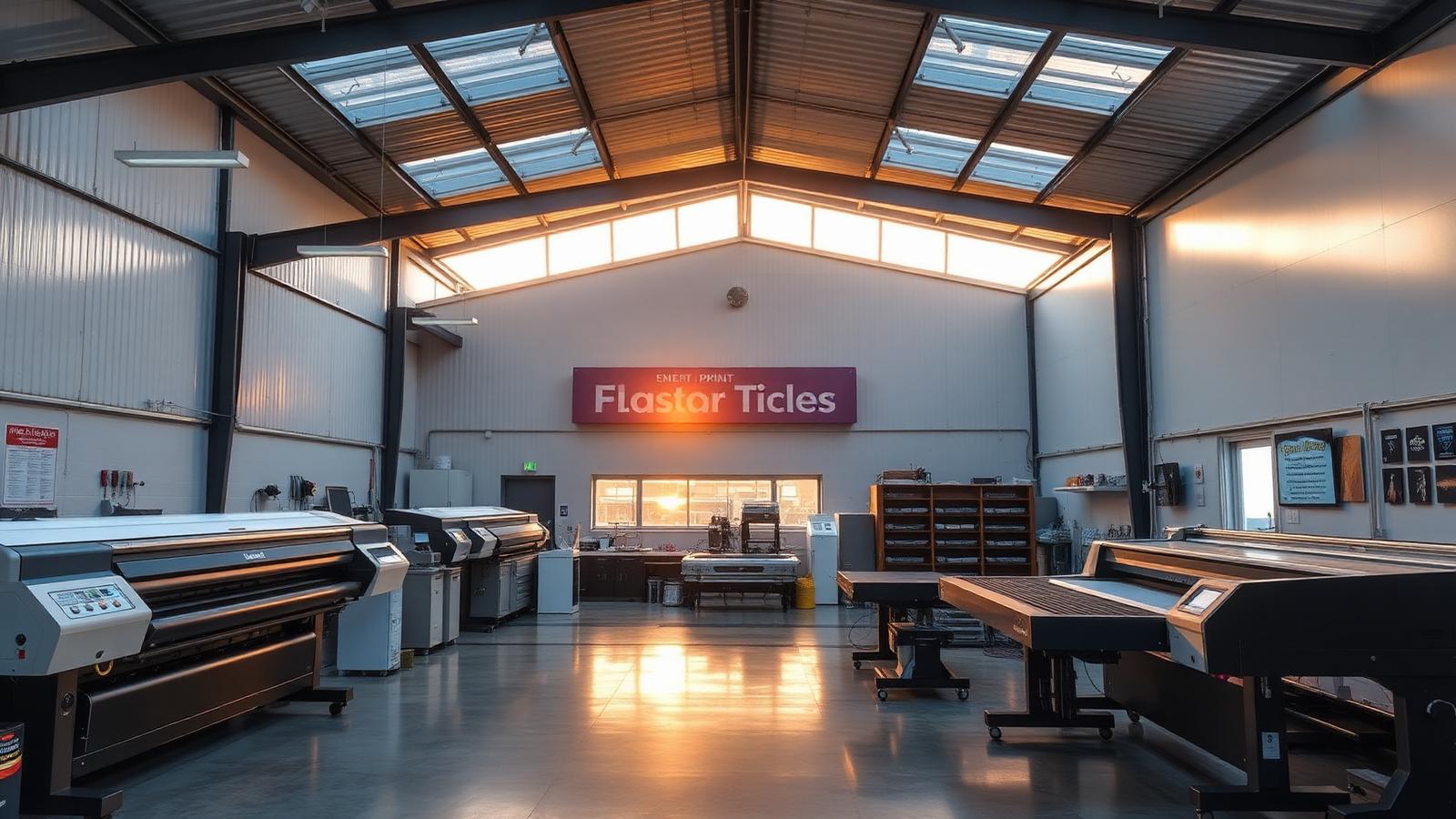
Roll-to-roll large-format printers (HP Latex 700/800 series, Roland TrueVIS VG3, Mimaki JV300/UJV100, Epson SureColor S-Series — typically 3–9 kW continuous per printer during print) and flatbed UV curing printers (swissQprint Nyala/Karibu, Durst P5, EFI VUTEk, Mimaki JFX — 8–22 kW continuous during print, with high-intensity LED-UV or mercury-arc curing lamps). Most Brisbane production shops run 2–6 large-format units + 1–2 flatbeds in concurrent rotation across an 8–14 hour production day. The load profile is overwhelmingly daytime (rip + print + finish during business hours) — solar self-consumption ratios on print shops are typically the best in any commercial sector, regularly 85–94%.
Finishing: laminators, cutters, plotters, CNC routers
Roll laminators (GMP, Drytac, Royal Sovereign — 3–8 kW intermittent), flatbed cutters and digital die-cutters (Zünd G3/S3, Esko Kongsberg, Summa F-Series — 4–9 kW with vacuum table pumps), vinyl plotters (Roland GR, Graphtec FC, Summa S Class — 1–3 kW), CNC routers for sign substrates and Dibond/ACM/acrylic (Multicam, Komo, Anderson — 7–22 kW with dust extraction), and large hot-shoe heat-press equipment for sublimation and apparel decoration. Aggregated finishing load is typically 12–28 kW continuous through the working day across a mid-size shop.
Compressed air & dust extraction (the silent waste)
Workshop air compressors for pneumatic finishing tools, signage assembly, vacuum tables and pneumatic registration (typically 11–37 kW with VSD on better-equipped shops) running continuously, and centralised dust extraction systems (Donaldson Torit, Camfil APC, Nederman — 11–30 kW) for CNC routing, sign-fabrication sanding and substrate cutting. Compressed air alone is typically 18–28% of total workshop electricity — and audits routinely find 25–45% of compressor energy is lost to undersized lines, leaks and inappropriate end-use. Air audits at solar install time typically save another $4–14k/yr on top of solar self-consumption.
Production lighting, colour booths & shopfront
Production-floor high-bay LED (essential for accurate colour matching — typically 500–750 lux at 5000K D50 daylight-matched throughout the print and finishing zones), dedicated colour-proofing booths to ISO 3664 standard (5000K viewing booths from JUST Normlicht, GTI, Verivide — for client proof sign-off), shopfront retail and signage display, customer-facing graphic design studio HVAC, and large illuminated external signage often used as the shop's own portfolio piece. Brisbane print shops in industrial estates (Salisbury, Geebung, Eagle Farm, Acacia Ridge) often have over-specified shopfront signage as marketing — solar makes that affordable to leave on 24/7.
Why Brisbane print shops are electrifying in 2026
Four reasons production shop owners, commercial print house operators and franchise network sites across South-East Queensland are signing solar contracts this year — beyond simple bill savings.
60–75% combined energy reduction
A typical mid-size Brisbane production shop (2 HP Latex + 1 swissQprint flatbed + Zünd cutter + CNC router + lamination) drops from $92k/yr to $26–34k/yr on a well-sized 80kW solar + 40kWh BESS + LED retrofit + compressed-air audit. Larger commercial print houses (Snap Print, Kwik Kopy multi-site, Print Together, Box & Dice, Worldwide Online, Officeworks B2B partners) with offset + digital + wide-format under one roof routinely save $120–220k/yr on 150–300kW installs. Print shop solar self-consumption ratios are typically the best in any commercial sector — regularly 85–94% — because the production day perfectly tracks the solar generation curve.
Best-in-class self-consumption ratio (85–94%)
Print shops have the cleanest daytime-load profile of any commercial sector we work with. RIP processing, large-format printing, flatbed UV curing, finishing, lamination, CNC routing and dust extraction all run concurrently from approximately 7am to 5pm, perfectly tracking the solar generation curve. This means typical self-consumption ratios of 85–94% — significantly better than retail (45–65%), hospitality (35–55%) or warehousing (55–75%). In practice this means you keep almost every kWh generated rather than exporting at low FiT rates, and battery sizing requirements are modest because there's little overnight load to cover. Net effect: shorter payback than essentially any other commercial sector.
PIAA / Visual Connections / Sustainable Green Print ready
Print Industry Association of Australia (PIAA), Visual Connections (signage industry), and Sustainable Green Print (SGP) certification all reward energy management and emissions reduction. SGP Level 1/2/3 certification — now required by many corporate procurement processes (banks, government tenders, Tier 1 retailers like Coles, Woolworths, Bunnings, Officeworks for in-house print panels) — explicitly scores renewable energy adoption. Brisbane shops chasing Sustainable Green Print Level 2 or 3 use solar as a primary credit. We provide documentation in PIAA, Visual Connections, SGP, NGER, Climate Active and GRI formats for tender response packs.
IAWO + STCs + LGCs + accelerated Div 40 depreciation
Print shop operating entities under $50M turnover deduct 100% of install cost in year of purchase under IAWO. STCs apply at purchase on systems up to 100kW (typically $25–45k off a full 100kW install). LGCs are created annually on systems above 100kW (typically $4–9k/yr on a 150kW system). Battery storage attracts the federal SMB battery incentive (up to $18k). Combined with print shops' best-in-sector self-consumption ratios, after-tax payback typically lands at 2.8–3.5 years — among the shortest payback periods of any commercial sector we install.
Real example: production print shop (Salisbury industrial)
Real Salisbury industrial-estate production shop — 2× HP Latex 700, 1× swissQprint Nyala flatbed UV, Zünd G3 flatbed cutter, Roland GR plotter, GMP roll laminator, Multicam M2412 CNC router with Donaldson Torit dust extraction, 22kW VSD Atlas Copco compressor, design studio + colour-proofing booth. 80kW rooftop solar across sawtooth-roof factory unit (north-facing planes), 40kWh BESS for demand-charge management on flatbed UV cycle starts, full compressed air audit and production-floor LED retrofit at install time.
Grid + leaky air, fluoro lighting, no demand management
- Electricity: 2 HP Latex + 1 swissQprint flatbed UV (production day)$26,400/yr
- Electricity: Zünd flatbed cutter + Roland plotter + lamination$11,800/yr
- Electricity: CNC router + dust extraction (continuous duty)$13,200/yr
- Electricity: 22kW VSD compressor (continuous duty)$14,500/yr
- Electricity: production-floor LED + colour booth + design studio HVAC$18,600/yr
- Electricity: shopfront, illuminated signage, EFTPOS, sundry$7,500/yr
- Total annual print shop bill$92,000/yr
80kW solar + 40kWh BESS + air audit + LED retrofit
- 80kW rooftop solar + 40kWh BESS—
- Self-consumed solar (best-in-sector 91% ratio)121,000 kWh
- Reduced grid imports$48,200/yr
- Compressed air audit savings (leaks + VSD optimisation)$8,400/yr
- Production-floor LED + colour-booth retrofit savings$6,200/yr
- Solar export FiT (only 9% exported)-$1,400/yr
- Net annual print shop bill$27,800/yr
Shop-sized packages
All proposals include shop audit (electrical + compressed air + production lighting), Energex commercial application, IAWO + STC/LGC documentation, demand-charge analysis, Sustainable Green Print documentation pack and 12-month performance guarantee.
40kW Boutique Shop
- Suits boutique production shop, no flatbed UV
- Sungrow / Fronius 3-phase commercial inverter
- Full STC rebate at purchase
- Printer + finishing sub-metering
- Compressed air audit included
- Production-floor LED retrofit feasibility
- 10-yr workmanship + 12-month performance guarantee
80kW + 40kWh + Air Audit
- Suits production shop with 2–4 large-format + flatbed UV + CNC
- VSD compressor audit + leak survey + line resize
- Production-floor LED + 5000K colour booth retrofit
- Federal SMB battery incentive applied
- Sustainable Green Print Level 2/3 documentation
- Demand-charge management on CNC + flatbed UV starts
- Energex commercial embedded gen approval
- 10-yr workmanship + 12-month performance guarantee
200kW+ Commercial Print House
- Suits commercial print house with offset + digital + wide-format
- 150–300 kWh BESS for full demand-charge management
- Annual LGC creation + sale included
- Tier 1 corporate tender documentation pack
- Sustainable Green Print Level 3 + Climate Active pathway
- Multi-site portfolio rollout coordination
- Capital / PPA / lease modelled side-by-side
Don't install print shop solar without a compressed-air audit and Sustainable Green Print pathway
The single most common print shop solar mistake is treating it as a standalone electricity-bill play and skipping the compressed-air audit + production-floor LED retrofit + Sustainable Green Print certification pathway. Compressed air is typically 18–28% of shop electricity with 25–45% of that wasted to leaks and oversized supply lines — a baseline audit at install time routinely saves another $4–14k/yr on top of solar generation. SGP Level 2/3 certification is now required by Tier 1 corporate and government procurement panels, and the documentation is largely a by-product of the solar + LED + air audit work. Insist your installer (1) includes a baseline compressed air audit (Atlas Copco / Kaeser methodology), (2) retrofits production-floor LED to 5000K D50 colour-matched standard, and (3) provides SGP-ready documentation as part of the install pack. The combined picture typically halves apparent payback and unlocks Tier 1 tender access at the same time.
Frequently asked questions
Production shop owner, commercial print house operator, signage workshop and franchise network site questions, answered.
Print on solar. Stop the air leaks. Win the Tier 1 tenders.
Free shop feasibility within 7 business days — covers electricity, compressed air audit, production-floor LED retrofit, demand-charge analysis and Sustainable Green Print documentation. Brisbane-wide — Salisbury, Geebung, Eagle Farm, Acacia Ridge, Wacol, Yatala, Northgate, Sunshine Coast and Gold Coast. Independent shops, commercial print houses, signage workshops and franchise networks (Snap, Kwik Kopy, Worldwide Online) welcome.