
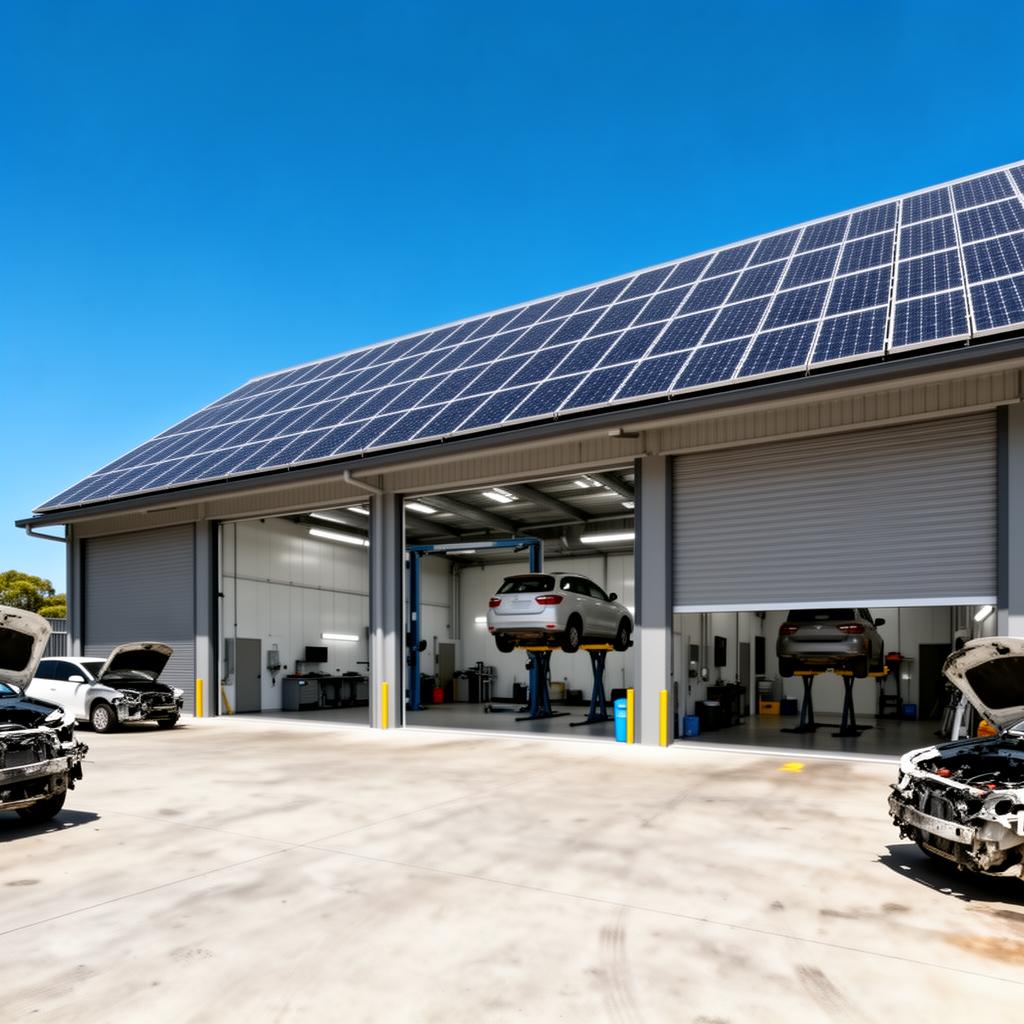
Solar for Brisbane Panel Beaters & Smash Repair Workshops
Cut your workshop's $42k–$280k combined power and gas bill by 55–75% with 30–150kW rooftop solar paired with electric IR bake retrofit and demand-charge battery. 3–4 year payback after STCs, IAWO and gas displacement — preferred-repairer audit ready, booth-throughput uplift included.
★ 4.9 / 23 smash repair installs · Electric bake retrofit specialists · Suncorp S.M.A.R.T / IAG ARC / Allianz ready
Where panel beater energy actually goes
Gas-fired spray booth bake cycles still dominate — typically 35–55% of total workshop energy. A solar-only retrofit captures the electricity half. The full play is solar + electric IR bake retrofit + demand-charge battery, which cuts cycle time, lifts throughput and neutralises gas exposure.
Spray booth bake cycles (the big one)
Spray booths (Saima, Garmat, USI Italia, Lutro — typical 7m down-draft cabin) draw 35–90 kW during spray cycles and step up to 50–180 kW during the 40–80°C bake cure cycle. Most Brisbane booths are gas-fired direct-burner or indirect-fired — making gas typically 35–55% of total workshop energy spend. Modern electric IR / heat-pump-assisted bake systems (Trisk Infrared, Garmat eCURE) cure 30–50% faster than gas at lower lifecycle cost when paired with solar, and the daytime bake cycle aligns perfectly with the solar curve.
Air compressors & dust extraction
Workshop air compressors (Atlas Copco, Kaeser, Champion — typically 22–75 kW with VSD on larger sites) running continuously across the working day to drive air tools, sanders, DA polishers, plasma cutters and booth atomisation. Centralised dust extraction systems (Donaldson Torit, Camfil APC — 15–55 kW) for wet/dry sanding stations and weld fume. Compressed air alone is typically 18–28% of workshop electricity — solar covers it completely during the day at exceptional self-consumption ratio.
Welding, spot-weld, MIG/MAG, aluminium repair
Resistance spot welders for high-strength-steel structural repair (Pro Spot, Car-O-Liner, Celette — 16–32 kVA peak per weld, sharp short-duration draw), MIG/MAG synergic welders (Fronius, Lincoln, Miller — 5–15 kW continuous duty), aluminium pulse welders and rivet-bonding equipment for modern aluminium-bodied vehicles (Audi, Range Rover, F-150). Sharp inrush profile drives demand charges on larger workshops — battery-supported demand shaping flattens this effectively.
Lifts, measuring systems, EV-ready bays & lighting
2-post and 4-post hoists (3–7 kW per lift, intermittent), chassis pulling and measuring systems (Car-O-Liner, Celette, Spanesi — 4–11 kW), aluminium 'clean room' bays, EV battery thermal-management quarantine zones for EV collision repair, high-CRI LED bay lighting (essential for colour-matched paint inspection — typically 200–500 lux at 5500K across every bay). Trade-trained EV repair is the fastest-growing service line in Australian smash repair and adds meaningful load that solar covers perfectly.
Why Brisbane workshops are electrifying in 2026
Four reasons workshop owners, network site managers and insurer-preferred-repairer operators across South-East Queensland are signing solar + electric-bake contracts this year — beyond simple bill savings.
55–75% combined energy reduction
A typical 8-bay Brisbane smash repairer with one downdraft spray booth drops from $118k/yr to $38–48k/yr on a well-sized 80kW solar + 60kWh BESS + electric IR bake retrofit. Larger 15+ bay multi-booth Capital S.M.A.R.T-style facilities routinely save $140–230k/yr on 150–250kW installs. Five years of compounded savings nearly always exceeds the install cost — and unlike insurer-claim margin (typically 12–22% on parts + labour after assessor adjustment), the savings are locked in for 25 years independent of insurer rate negotiations.
Insurer-network ESG scoring & preferred-repairer status
Major insurers (Suncorp Group inc. AAMI / GIO / Apia / Bingle, IAG Group inc. NRMA / RACV / SGIO / CGU, Allianz, Youi, Hollard) increasingly include workshop sustainability metrics in network audits and preferred-repairer assessments. Suncorp's Capital S.M.A.R.T network and IAG's Australian Repair Centre (ARC) network both publish renewable-energy targets across their wholly-owned and partnered repair networks. Independent workshops chasing or maintaining preferred-repairer status now use solar installation as a scored differentiator — we provide documentation in the formats required by all major insurer audit teams.
Electric IR / heat-pump bake eliminates gas exposure
Modern electric infrared and heat-pump-assisted bake systems (Trisk Infrared, Garmat eCURE, USI Italia Energy Saver) cure paint 30–50% faster than gas at the same finish quality, with no combustion air handling and significantly less booth thermal lag. Pairing solar with electric bake eliminates the daytime gas bill and typically halves cycle time — directly increasing booth throughput, which is the single largest revenue constraint on most smash repairers. The throughput uplift often funds the install on its own, with energy savings as the secondary benefit. 2026 network gas charges are escalating 8–15%/yr on commercial connections.
IAWO + STCs + LGCs + accelerated depreciation
Independent smash repairers under $50M turnover deduct 100% of install cost in year of purchase under IAWO. STCs apply at purchase on systems up to 100kW (typically $25–45k off a full 100kW install). LGCs are created annually on systems above 100kW (typically $4–9k/yr on a 150kW system). Battery storage and electric bake equipment attract accelerated Div 40 depreciation. Combined with gas displacement and throughput uplift, after-tax payback typically lands at 2.8–3.5 years — exceptional in the automotive trades sector.
Real example: 8-bay Brisbane smash repairer (Acacia Ridge industrial)
Real 8-bay Acacia Ridge industrial smash repairer — 1 down-draft spray booth (gas bake, 6 cycles/day), 55kW VSD air compressor, Donaldson dust extraction, 4 hoists, Car-O-Liner measuring system, dedicated aluminium bay, EV-collision-repair bay. 80kW rooftop solar, 60kWh BESS for demand-charge management, Trisk Infrared + Garmat eCURE electric bake retrofit on existing booth.
Grid + heavy gas, slow bake cycles, throughput-limited
- Natural gas: spray booth bake cycles (1 booth, 6 bakes/day)$42,000/yr
- Electricity: air compressor + dust extraction (continuous)$28,400/yr
- Electricity: welding (spot + MIG/MAG + aluminium)$14,800/yr
- Electricity: lifts, measuring, EV-ready bay, sanders$11,200/yr
- Electricity: LED bay lighting + office HVAC + signage$15,600/yr
- POS, office computing, hot water, sundry$6,000/yr
- Total annual workshop bill$118,000/yr
80kW solar + 60kWh BESS + electric IR bake
- 80kW rooftop solar + 60kWh BESS—
- Self-consumed solar + battery cycling127,000 kWh
- Reduced grid imports$42,800/yr
- Gas eliminated (electric IR bake retrofit, Trisk + Garmat)$38,000/yr
- Booth throughput uplift (extra ~2 jobs/wk, gross margin)$24,000/yr
- Solar export FiT-$1,800/yr
- Net annual workshop bill (energy only, before throughput)$45,400/yr
Workshop-sized packages
All proposals include workshop audit (electrical + gas + booth), Energex/grid application, IAWO + STC/LGC documentation, demand-charge analysis, electric bake retrofit feasibility, insurer-network ESG reporting pack and 12-month performance guarantee.
30kW Independent / Mechanical+Body
- Suits 3–5 bay independent body shop
- Sungrow / Fronius / SMA commercial inverter
- Full STC rebate at purchase
- Compressor + booth sub-metering included
- Battery-ready for later add-on
- Electric-bake feasibility included
- 10-yr workmanship + 12-month performance guarantee
80kW + 60kWh + Electric Bake
- Suits 6–10 bay smash repairer with 1 spray booth
- Trisk Infrared or Garmat eCURE electric bake retrofit
- Booth + compressor demand-charge management
- Federal SMB battery incentive applied
- Insurer-network ESG reporting (Suncorp/IAG/Allianz)
- EV-collision-repair bay sub-board ready
- Energex commercial embedded gen approval
- 10-yr workmanship + 12-month performance guarantee
150kW+ Multi-Booth / Network Site
- Suits 15+ bay multi-booth Capital S.M.A.R.T / ARC-style site
- 100–250 kWh BESS for full demand-charge management
- Multi-booth staged electrification
- Annual LGC creation + sale included
- Insurer-network preferred-repairer documentation pack
- Multi-site portfolio rollout coordination
- Capital / PPA / lease modelled side-by-side
Don't install workshop solar without modelling booth throughput uplift
The single most common smash repair solar mistake is treating it as purely an energy-bill play and ignoring the booth-throughput case. Spray booth cycle time is the single largest revenue constraint on most repairers — and modern electric IR / heat-pump-assisted bake systems cut cycle time 30–50%, meaning meaningful extra jobs through the booth each week. On a typical 8-bay workshop that's $20–40k/yr in additional gross margin — often larger than the direct energy savings. Insist your installer (1) models electric bake retrofit alongside solar, (2) quantifies the throughput uplift in jobs per week and gross margin per job, and (3) includes that uplift in the payback calculation. The combined picture typically halves the apparent payback time and changes the financing conversation entirely.
Frequently asked questions
Workshop owner, network site manager, insurer-preferred-repairer and multi-site operator questions, answered.
Halve bake time. Crush the gas bill. Lock in preferred-repairer status.
Free workshop feasibility within 7 business days — covers electricity, gas, booth electrification, demand-charge analysis and insurer-network ESG reporting. Brisbane-wide — Acacia Ridge, Logan, Yatala, Wacol, Geebung, Northgate, Sunshine Coast, Gold Coast. Independent, multi-site, Capital S.M.A.R.T, IAG ARC and Allianz preferred-repairer operators welcome.