
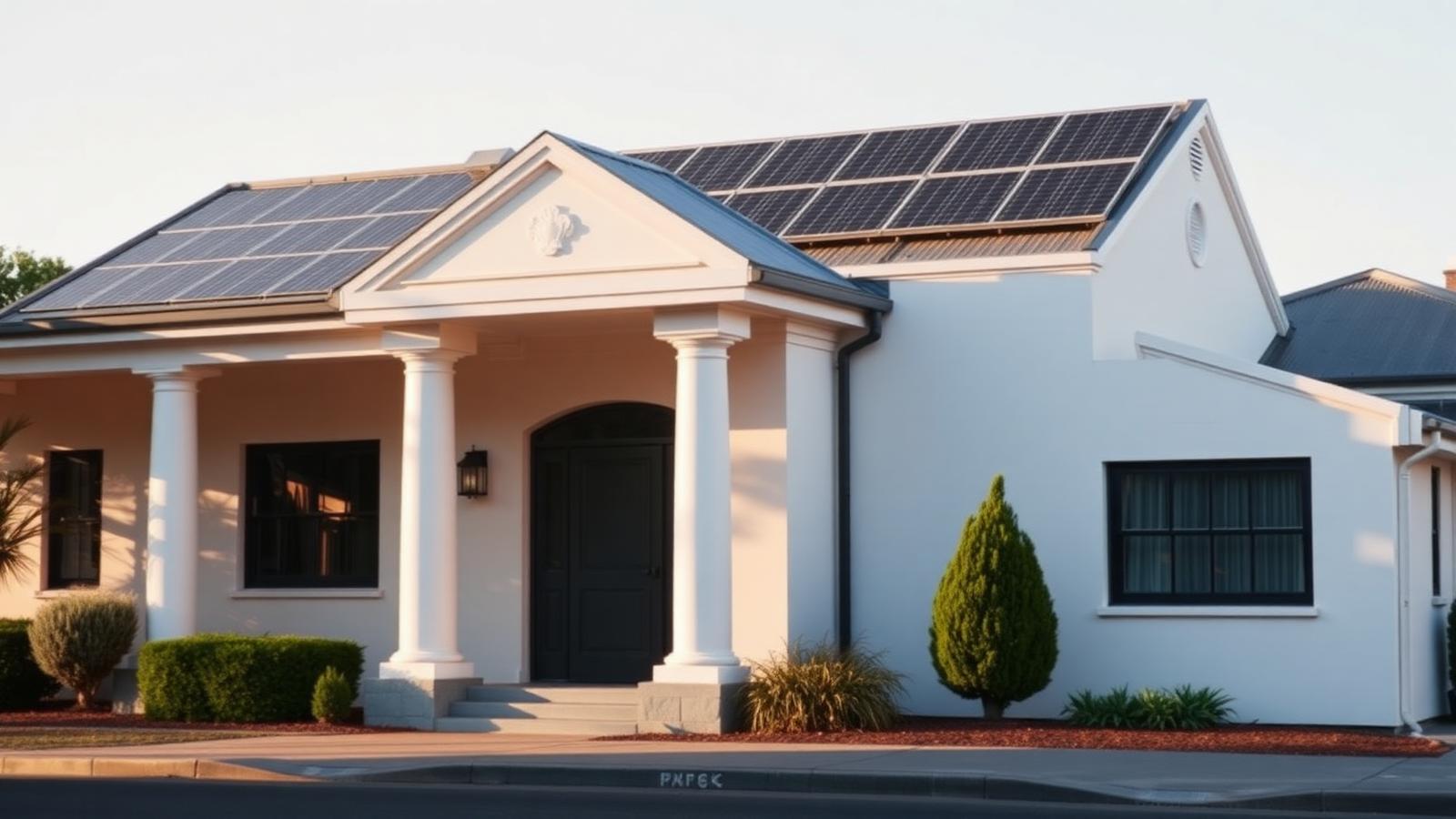
Solar for Brisbane Funeral Homes & Cemeteries
Cut your funeral home's $48k–$420k power bill by 55–70% with 40–250kW rooftop solar paired with mortuary cool-room refrigeration upgrade, chapel HVAC demand management and battery-backed critical-load UPS. 4–5 year payback after STCs, LGCs and IAWO — dignified, discreet, street-invisible install on every site.
★ 4.9 / 14 funeral home installs · Mortuary refrigeration specialists · AFDA / FIAQ / heritage-overlay ready
Where funeral home energy actually goes
Mortuary refrigeration runs 24/7 as a non-negotiable baseline. Chapel and reception HVAC peak in daylight hours during services — aligning naturally with the solar curve. The full play is solar + battery-backed mortuary UPS + cool-room refrigeration upgrade, which protects dignity of care AND cuts the bill.
Mortuary refrigeration (the silent 24/7 baseline)
Mortuary cool rooms held at 2–4°C and freezer units at -18°C run continuously, 365 days a year, with non-negotiable temperature stability for dignified care of the deceased. Typical mid-size funeral home: 8–24 body refrigeration capacity, 12–28 kW connected refrigeration load (Thermo King / Carrier / Kolpak mortuary plant), often with redundant compressors. This is the most temperature-critical 24/7 load in the building and the most expensive to lose to outage — solar covers the daytime cycle and battery handles overnight + standby resilience without compromise to dignity or compliance.
Chapel HVAC, reception suites & viewing rooms
Modern multi-chapel funeral homes (typical 80–200 seat main chapel plus 30–60 seat reception lounge and 2–4 family viewing rooms) require precise climate control during services — typically 22–24°C with humidity management for floral arrangements and audio-visual equipment. Service times concentrate in daylight hours (10am–3pm peak), which aligns perfectly with the solar generation curve. Chapel HVAC is the second-largest electricity line on most Brisbane funeral home bills (typically 28–38% of total).
Crematoria: standby load, exhaust & retort cooling
Modern gas-fired cremators (B&L Cremation Systems, Matthews IES, Facultatieve Technologies — typically 350–600kW gas firing per retort during cremation cycle) cannot economically be electrified on solar — the firing load is too peak-heavy. But the surrounding loads CAN: pre-warming, retort cooling fans (post-cycle, 4–8 hour run-down), exhaust scrubber pumps, ash-processing equipment (cremulator, magnetic recovery), facility HVAC during the entire 2–4 hour cycle, and overnight standby maintenance. These solar-coverable loads typically represent 35–55% of the cremator's total annual electricity profile — and 100% of the daytime load.
Cemetery grounds, irrigation & memorial gardens
Cemetery operators (typically Brisbane City Council, Centennial Park Cemetery Authority, Centaurus, Mount Gravatt, Pinnaroo, Albany Creek) manage large turf areas with automated irrigation (12–35 kW pump stations, typically running overnight), memorial garden water features, columbarium lighting, chapel-of-rest buildings, administration offices and groundskeeper plant rooms. Pump stations are typically the largest discrete load. Daytime tank-filling on solar (instead of overnight grid pumping) restructures the irrigation duty cycle to align with solar generation — often achievable with minimal capital outside the solar install itself.
Why Brisbane funeral homes are electrifying in 2026
Four reasons independent funeral homes, group-affiliated sites (InvoCare, Propel, Newhaven, Tobin) and cemetery operators across South-East Queensland are signing solar contracts this year — beyond simple bill savings.
55–70% combined energy reduction
A typical mid-size 2-chapel Brisbane funeral home with on-site mortuary drops from $135k/yr to $48–62k/yr on a well-sized 100kW solar + 80kWh BESS + LED chapel retrofit + R290 cool-room refrigeration upgrade. Larger group sites (InvoCare Le Pine / White Lady / Simplicity, Propel Funeral Partners, Bowra & O'Dea, Newhaven, Tobin Brothers, Drysdale Funerals) with multiple chapels and on-site crematoria routinely save $180–340k/yr on 200–400kW installs. Cemetery operations on large grounds with major pump-station load see step-change savings on irrigation duty alone — often $35–95k/yr.
Dignified, discreet, heritage-sensitive install
Solar on a funeral home is fundamentally different from solar on a warehouse — the install must preserve the dignity, character and visual gravity of the property. We design every funeral home install with discretion as the primary criterion: panels placed on rear roof planes invisible from street, chapel and porte-cochère elevations, all-black aesthetics (Trina Vertex S+ all-black or REC Alpha Pure Black), recessed conduits with no visible cable runs, no roof-edge signage or installer branding. Heritage-listed funeral homes (Cannon & Cripps, Drysdale Hamilton, K.M. Smith East Brisbane) receive Council heritage-overlay consultation as part of feasibility. Visitors and bereaved families should not notice the install exists.
AFDA, Funeral Industry Association & ISO 14001 ready
Australian Funeral Directors Association (AFDA) Code of Professional Conduct, Funeral Industry Association of Queensland (FIAQ) standards, and ISO 14001 Environmental Management certification all reward energy management and emissions reduction. Group operators (InvoCare ASX:IVC, Propel Funeral Partners ASX:PFP) publish Scope 1/2/3 emissions in annual reports and are increasingly assessed by ESG analysts and ethical investment funds. Independent funeral homes seeking acquisition by these groups, or seeking pre-paid funeral plan partnerships with Australian Friendly Society, Foresters Financial or Funeral Plan Management, benefit from documented sustainability credentials. We provide reporting in AFDA, FIAQ, ISO 14001, NGER, GRI and TCFD formats.
IAWO + STCs + LGCs + accelerated Div 40 depreciation
Independent funeral home operating entities under $50M turnover deduct 100% of install cost in year of purchase under IAWO. STCs apply at purchase on systems up to 100kW (typically $25–45k off a full 100kW install). LGCs are created annually on systems above 100kW (typically $4–10k/yr on a 150kW system). Mortuary refrigeration upgrade equipment and chapel HVAC retrofit attract accelerated Div 40 depreciation. For group operators, install-cost capitalisation against EBITDA on multi-site rollouts typically lifts portfolio valuation multiples by a measurable 0.3–0.7× — relevant if positioning for further private equity capital raises or trade sale.
Real example: 2-chapel funeral home (Brisbane northside, on-site mortuary)
Real 2-chapel Brisbane northside funeral home — main 140-seat chapel, 60-seat reception lounge, 3 family viewing rooms, on-site 16-body mortuary cool room + 4-body freezer, dressing rooms, casket display, floral cool room, hearse garage with charger. 100kW rooftop solar (rear roof planes, all-black panels, completely street-invisible), 80kWh BESS for mortuary UPS + chapel HVAC demand management, R290 mortuary refrigeration retrofit with heat-recovery to hot water, heat-pump HWS retrofit eliminating gas.
Grid + gas hot water, R404A mortuary, no battery UPS
- Electricity: mortuary refrigeration (24/7 cool + freezer)$32,800/yr
- Electricity: chapel + reception suite HVAC (3 spaces)$42,400/yr
- Electricity: viewing rooms, family lounge, dressing rooms$14,200/yr
- Electricity: floral cool room + casket display + office HVAC$19,600/yr
- Electricity: AV systems, lighting, signage, hearse charging$18,000/yr
- Gas: hot water + kitchen for catered receptions$8,000/yr
- Total annual funeral home bill$135,000/yr
100kW solar + 80kWh BESS + R290 mortuary + heat-pump HWS
- 100kW rooftop solar (rear roof planes, all-black, street-invisible)—
- 80kWh BESS + LED chapel retrofit + R290 cool-room refrigeration—
- Self-consumed solar + battery cycling152,000 kWh
- Reduced grid imports$56,400/yr
- Mortuary refrigeration upgrade (R290 + heat-recovery to hot water)$14,800/yr
- Gas hot water eliminated (heat-pump HWS retrofit)$8,000/yr
- Solar export FiT + LGC sale-$3,400/yr
- Net annual funeral home bill$52,200/yr
Funeral-home-sized packages
All proposals include site audit (electrical + gas + mortuary refrigeration + chapel HVAC), Energex commercial application, IAWO + STC/LGC documentation, heritage-overlay consultation if applicable, AFDA-aligned dignified-install engineering and 12-month performance guarantee.
40kW Single-Chapel Home
- Suits single-chapel funeral home with on-site mortuary
- All-black panels (Trina Vertex S+ or REC Alpha Pure Black)
- Rear-plane discreet install · street-invisible
- Full STC rebate at purchase
- Mortuary refrigeration audit included
- AFDA-aligned dignity-first engineering
- 10-yr workmanship + 12-month performance guarantee
100kW + 80kWh + Cool-Room
- Suits 2-chapel funeral home with on-site mortuary
- R290 cool-room refrigeration retrofit with heat-recovery to hot water
- Mortuary cool-room UPS backup (4–6 hr blackout cover)
- Federal SMB battery incentive applied
- Heritage-overlay consultation if applicable
- AFDA / FIAQ / ISO 14001 sustainability reporting
- Heat-pump HWS retrofit included
- 10-yr workmanship + 12-month performance guarantee
200kW+ Multi-Site / Crematorium
- Suits multi-chapel funeral home with on-site crematorium
- Cremator standby + retort cooling + exhaust scrubber coverage
- 150–300 kWh BESS for full demand-charge management
- Annual LGC creation + sale included
- Group ESG reporting (InvoCare / Propel / Newhaven compatible)
- Multi-site portfolio rollout coordination
- Capital / PPA / lease modelled side-by-side
Don't install funeral home solar without battery-backed mortuary UPS
The single most important non-financial consideration on a funeral home install is mortuary refrigeration resilience. Cool rooms (2–4°C) and freezer units (-18°C) holding deceased in our temporary custody cannot lose temperature stability under any circumstances — both for compliance with FIAQ standards and for the fundamental dignity of care. A solar-only install that doesn't include battery-backed UPS coverage on mortuary refrigeration leaves a critical gap that the cost saving never justifies. Insist your installer (1) sizes BESS to maintain mortuary refrigeration for at least 6–12 hours on critical-load-only priority, (2) configures critical-load prioritisation ahead of chapel HVAC and office systems, and (3) documents the resilience plan in AFDA / FIAQ format. Funeral home solar is fundamentally about dignified continuity of care first — the bill savings are the secondary benefit.
Frequently asked questions
Independent funeral home, group-affiliated site, crematorium and cemetery operator questions, answered.
Dignified, discreet solar. Protected mortuary care. Quiet bill savings.
Free funeral home feasibility within 7 business days — covers electricity, gas, mortuary refrigeration, chapel HVAC, battery UPS resilience and AFDA / FIAQ documentation. Brisbane-wide — Wickham Terrace, Hamilton, East Brisbane, Mount Gravatt, Strathpine, Cleveland, Logan, Ipswich, Sunshine Coast and Gold Coast. Independent, group-affiliated (InvoCare, Propel, Newhaven, Tobin), heritage-listed and cemetery operators welcome.