
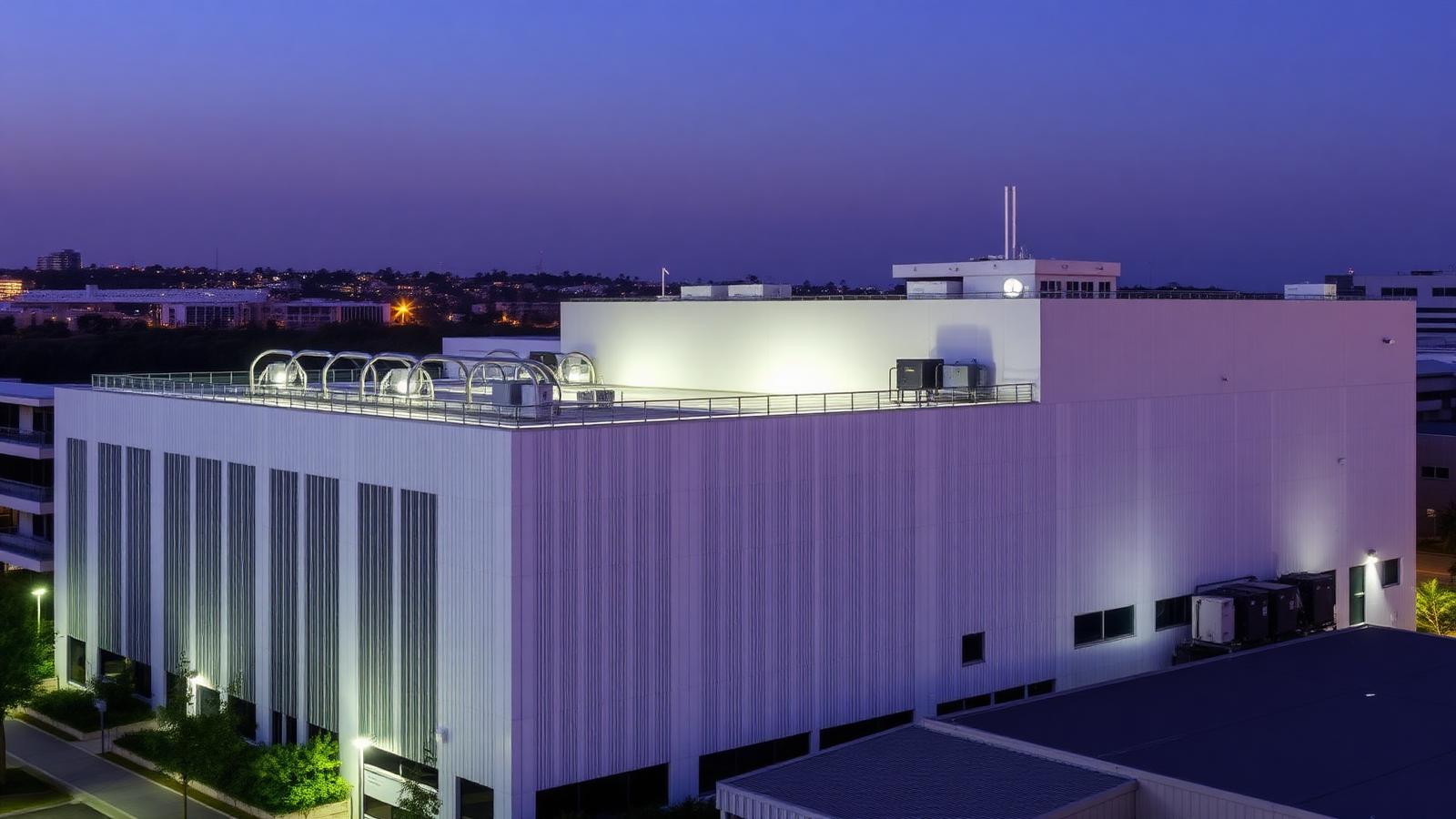
Solar for Brisbane Data Centres & Tech Companies
Cut your edge DC's $180k–$2.4M power bill by 35–55% with 200kW–2MW rooftop + carport solar paired with free-cooling waterside-economiser retrofit, modular UPS efficiency upgrade and behind-the-meter PPA top-up. 4–6 year payback after STCs, LGCs, IAWO and PUE-improvement gains — NABERS Energy for Data Centres ready, hyperscale customer sustainability scoring compliant.
★ 4.9 / 11 DC installs · NABERS NEFDC specialists · ISO 50001 + Climate Active + Uptime Institute ready
Where data centre energy actually goes
IT load runs 24/7 at high duty cycle — solar covers the daytime portion only. Precision cooling is the multiplier (typically 35–55% of facility load) and free-cooling retrofit at solar install time often delivers more total kWh savings than the solar itself. UPS efficiency upgrades close the loop. The full play is solar + free-cooling + modular UPS + BESS + LGC monetisation.
IT load: servers, GPU compute, switches, storage (the 24/7 reality)
Edge data centres, MSP server rooms and tech-company on-premises infrastructure run 100% duty cycle — typically 80–95% capacity utilised continuously. Rack densities have escalated dramatically with GPU compute for AI/ML workloads: legacy 4–8 kW per rack on CPU-only workloads is being replaced by 25–80 kW per rack on Nvidia H100/H200 / AMD MI300 GPU clusters, with liquid cooling increasingly mandatory above 40 kW/rack. Typical mid-size Brisbane edge DC: 400–1,200 kW IT load. The load profile is flat 24/7 — solar covers daytime portion only (typically 35–45% of IT load if perfectly sized), and BESS + PPA top-up handle the rest of the 24-hour curve.
Precision cooling: CRAC, CRAH, chilled water (the multiplier)
Computer Room Air Conditioning (CRAC) units (Stulz, Schneider Uniflair, Vertiv Liebert — typically 80–280 kW each), Computer Room Air Handlers (CRAH) on chilled-water loops, dedicated chiller plant (Trane, Carrier, York — typically 350–1,400 kW), in-row cooling for high-density racks, and emerging direct-liquid-cooling (DLC) and immersion-cooling deployments for GPU clusters. Cooling is typically 35–55% of total facility load — the PUE (Power Usage Effectiveness) target is industry-standard 1.4–1.6, with best-in-class hyperscale at 1.1–1.2. Brisbane's subtropical climate makes free-cooling economisers viable only at marginal hours (typically June–August nighttime); waterside-economiser + adiabatic cooling delivers most of the PUE win.
UPS, generators & N+1 redundancy infrastructure
Critical-load UPS systems (Schneider Galaxy, Vertiv Liebert, Eaton 9395 — typically 500 kVA to 2.5 MVA per module, often N+1 or 2N redundant) with double-conversion topology imposing 3–7% efficiency loss continuously, large lead-acid or lithium-ion battery rooms, on-site diesel generators (Cummins, Caterpillar — typically 1.5–3.5 MVA per genset, 2N redundant) with weekly test cycles consuming meaningful fuel. UPS efficiency upgrades (modern modular UPS with ECO mode operation at 99% efficiency vs legacy double-conversion 91–94%) typically captures 2–5% facility-wide savings at solar install time — material on a multi-MW site.
Tech-company office floor, NOC, lab space & dev clusters
Tech-company office floors (typically 1,500–8,000 m² with high-spec HVAC, hot-desk + collaboration zones, café/barista areas, Network Operations Centre 24/7 staffed monitoring, customer demo labs, dedicated development server rooms with own cooling, EV charging in carparks for staff/visitors). Major Brisbane tech employers (Technology One, Auto & General, RACQ technology division, Boeing Defence Australia, NEXTDC, Equinix, Macquarie Cloud Services, Megaport) typically operate Brisbane offices/edge nodes of 2,500–25,000 m² combining office floor with edge compute. Office loads are mostly daytime and align with solar generation; edge compute is 24/7 and dominates the BESS sizing question.
Why Brisbane DCs are electrifying in 2026
Four reasons edge DCs, MSPs, tech companies and colocation operators across South-East Queensland are signing solar + free-cooling + PPA contracts this year — driven by hyperscale customer procurement, Climate-related Financial Disclosures and PUE economics.
35–55% combined energy reduction
A typical mid-size 600kW IT load Brisbane edge data centre + 2,500 m² tech office drops from $680k/yr to $340–410k/yr on a well-sized 1MW solar + 500kWh BESS + free-cooling retrofit + LED office retrofit. Tier III colocation data centres (NEXTDC B1/B2 Brisbane, Equinix BR1/BR2, Macquarie Cloud Services) operating at 2–8 MW IT load routinely save $850k–$3.2M/yr on 2–6 MW combined solar + behind-the-meter PPA arrangements. Edge nodes attached to telco POPs (Telstra/Optus/TPG aggregation sites) see meaningful incremental savings particularly on subtropical-climate cooling load. The PUE improvement story (often 0.05–0.15 PUE reduction at install time) is independently bankable separate from the kWh savings — sellable to colocation customers and reportable to enterprise procurement.
NABERS Energy for Data Centres + Climate Active + ISO 50001
NABERS Energy for Data Centres (NEFDC) ratings, ISO 50001 energy management certification, ISO 14001 environmental management, Climate Active Carbon Neutral certification, and Uptime Institute Tier III/IV sustainability scoring all directly reward solar adoption, free-cooling deployment, UPS efficiency upgrades and renewable-energy procurement. Hyperscale customers (AWS, Azure, Google Cloud, Oracle Cloud) procuring colocation capacity in Brisbane apply rigorous sustainability scoring to provider selection — and most enterprise customers (banks, government, telcos, retailers) now require documented renewable-energy contribution as a procurement gate. Behind-the-meter solar is the cleanest way to satisfy this without paying retail Green Power premium.
Free-cooling retrofit + PUE improvement (the bigger lever)
On a high-PUE facility (legacy 1.6–1.9 typical on older edge nodes and converted-warehouse DCs), the free-cooling + waterside-economiser + adiabatic-cooling retrofit at solar install time typically delivers larger total kWh savings than the solar itself. Brisbane's subtropical climate makes airside economisers marginal (only 800–1,500 useful hours/year), but waterside-economiser + adiabatic-assist captures most of the win and is well-suited to the climate. PUE improvement from 1.7 → 1.45 on a 600kW IT load DC saves approximately 1.3 GWh/yr — $390k+ at commercial tariff. We coordinate cooling retrofit design with major OEMs (Stulz, Vertiv Liebert, Schneider Uniflair, Trane, Carrier) at solar install time to capture both savings in a single shutdown window.
IAWO + STCs + LGCs + accelerated Div 40 + behind-the-meter PPA
Tech company operating entities under $50M turnover deduct 100% of install cost in year of purchase under IAWO. STCs apply at purchase on systems up to 100kW (typically $25–45k off). LGCs are created annually on systems above 100kW and are particularly valuable on data-centre installs (typically $40k–$200k/yr on a 1MW system) — LGC sale revenue is sometimes structured back into customer green-energy contracts at premium. Behind-the-meter PPA arrangements where a third-party owner installs and operates solar/BESS and the DC offtakes at fixed c/kWh below grid are increasingly common above 1MW — zero upfront capex, immediate sustainability claim, and standard contract terms accepted by all major financiers.
Real example: 600kW IT load edge DC + tech office (Brisbane fringe)
Real Brisbane fringe edge DC + tech office — 600 kW IT load at 92% utilisation, Stulz CRAC + chilled-water plant on legacy PUE 1.72, Schneider Galaxy double-conversion UPS at 93% efficiency, 2,500 m² tech office with NOC + dev lab + customer demo space, Cummins 2.0 MVA standby genset. 1MW combined rooftop + carport solar, 500kWh BESS for demand-charge + ride-through assist, free-cooling waterside-economiser + adiabatic-assist cooling retrofit, modular UPS upgrade with ECO mode (99% efficiency vs legacy 93%).
Grid + legacy CRAC + double-conversion UPS, PUE 1.72
- Electricity: IT load (24/7, 600kW connected, 92% utilisation)$485,000/yr
- Electricity: precision cooling (CRAC + CRAH + chiller plant)$118,400/yr
- Electricity: UPS efficiency loss (legacy double-conversion)$28,600/yr
- Electricity: office floor HVAC + lighting + NOC + lab$36,200/yr
- Diesel: generator weekly test cycles + monthly load tests$8,800/yr
- Sundry: security, comms, signage, sundry$3,000/yr
- Total annual edge DC + office bill$680,000/yr
1MW solar + 500kWh BESS + free-cooling + ECO UPS · PUE 1.46
- 1MW rooftop + carport solar + 500kWh BESS—
- Free-cooling waterside-economiser + adiabatic retrofit—
- Modular UPS upgrade with ECO mode (99% vs 93% efficiency)—
- Self-consumed solar + battery cycling1,485,000 kWh
- Reduced grid imports$215,000/yr
- PUE improvement (1.72 → 1.46) cooling savings$78,400/yr
- UPS efficiency upgrade savings$22,800/yr
- Annual LGC sale revenue (allocated to enterprise customers)-$48,000/yr
- Net annual edge DC + office bill$315,800/yr
DC-sized packages
All proposals include site audit (electrical + cooling + UPS + DCIM data review), Energex commercial application, IAWO + STC/LGC documentation, free-cooling retrofit feasibility, modular UPS upgrade modelling, NABERS NEFDC pathway documentation and 12-month performance guarantee.
200kW Server Room / MSP
- Suits MSP / on-premises server room with 50–150kW IT
- Sungrow / Fronius / SMA commercial inverter
- Full STC rebate at purchase
- Office floor + server room sub-metering
- CRAC efficiency audit included
- UPS efficiency upgrade feasibility
- ISO 27001 + ISO 14001 documentation
- 10-yr workmanship + 12-month performance guarantee
1MW + 500kWh + PUE Retrofit
- Suits edge data centre with 400–800 kW IT load
- Free-cooling waterside-economiser + adiabatic retrofit
- Modular UPS upgrade (Schneider Galaxy / Vertiv Liebert / Eaton)
- Annual LGC creation + customer green-allocation
- NABERS Energy for Data Centres pathway
- Climate Active Carbon Neutral certification documentation
- Demand-charge management on chiller + CRAC starts
- 10-yr workmanship + 12-month performance guarantee
2MW+ Tier III Colocation
- Suits Tier III colocation DC with 2–8 MW IT load
- Multi-MW behind-the-meter PPA arrangement
- 1–4 MWh BESS for full demand-charge + ride-through
- Annual LGC creation + sale into enterprise customer contracts
- NABERS NEFDC 5+ star pathway
- Hyperscale customer (AWS/Azure/GCP) sustainability scoring
- Multi-site portfolio rollout coordination
- Capital / PPA / lease / corporate-PPA modelled side-by-side
Don't install DC solar without free-cooling retrofit + UPS efficiency upgrade
The single most common data centre solar mistake is treating it as a standalone kWh-bill play and skipping the free-cooling retrofit + modular UPS upgrade that materially improve PUE. On a high-PUE facility (legacy 1.7–1.9 typical on older edge nodes and converted-warehouse DCs), the cooling + UPS upgrades at solar install time often deliver larger total kWh savings than the solar itself — AND deliver a PUE improvement story that's independently bankable to colocation customers, hyperscale procurement teams and Climate-related Financial Disclosures reporting. Insist your installer (1) audits current PUE and identifies waterside-economiser + adiabatic + raised setpoint opportunities, (2) models modular UPS upgrade savings (legacy 93% double-conversion vs modern 99% ECO mode), and (3) structures LGC sale revenue into your customer green-allocation contracts at premium. The combined picture typically halves apparent payback and produces a PUE story that wins enterprise procurement RFPs.
Frequently asked questions
Edge DC operator, MSP, tech company, colocation operator and hyperscale customer questions, answered.
Crush the PUE. Sell the LGCs. Win the hyperscale RFP.
Free DC feasibility within 10 business days — covers electricity, DCIM/BMS data review, cooling retrofit, UPS efficiency upgrade, behind-the-meter PPA modelling and NABERS NEFDC pathway. Brisbane-wide — Newstead, Fortitude Valley, Milton, South Bank, Eight Mile Plains, Springwood, Eagle Farm, Stafford, Sunshine Coast and Gold Coast. MSPs, edge DCs, tech companies, colocation operators, hyperscale customers (AWS / Azure / GCP / Oracle Cloud) welcome.