
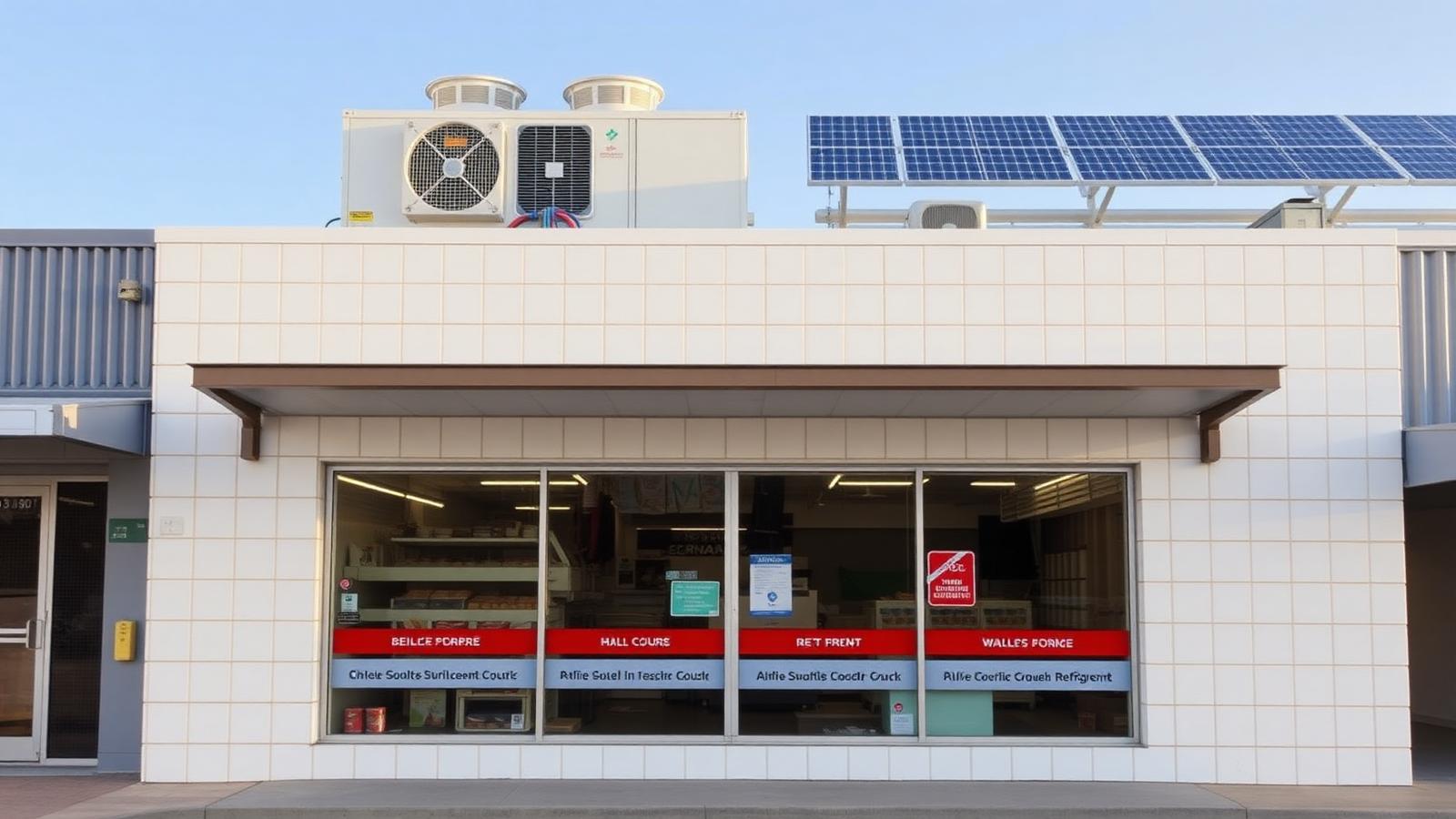
Solar for Brisbane Butchers & Smallgoods Makers
Cut your shop's $42k–$310k power bill by 60–75% with 40–250kW rooftop solar paired with R290/R744 refrigeration retrofit, condenser heat-recovery to sanitation hot water and battery-backed cold-chain UPS. 3–4 year payback after STCs, IAWO and HFC phase-down rebates — HACCP audit-ready, insurance-discount qualified.
★ 4.9 / 18 butcher/smallgoods installs · R290 retrofit specialists · PrimeSafe / Safe Food QLD ready
Where butcher & smallgoods energy actually goes
Refrigeration dominates — 24/7 cool rooms, display chillers and blast freezers typically run 55–72% of total electricity. Smokehouses and hot-water sanitation add daytime spikes. The full play is solar + R290/R744 retrofit + condenser heat-recovery + battery cold-chain UPS, which cuts the bill AND removes the single largest stock-loss risk on the site.
Cool rooms, display chillers & blast freezers (the 24/7 base)
Walk-in cool rooms held at 1–4°C (typically 12–60 m³ per chamber, Kolpak/Bondor/Coolroom Hire spec), retail display chillers (typically 4–7m run of Tasman/Ranco/Skope), blast freezers for game meat and smallgoods curing (Friginox, Sveba Dahlen, Williams — -32 to -40°C), and -18°C bulk freezer storage. Aggregate refrigeration load on a mid-size Brisbane butcher is typically 18–45 kW continuous with significant midday compressor cycling. Refrigeration alone is 55–72% of total electricity — and solar covers the daytime cycle perfectly while battery handles overnight base load. R404A/R22 plant past economic life can be coordinated with R290 (propane) or R744 (CO2) retrofit at solar install time for HFC phase-down compliance under the Ozone Protection Act 2024 amendments.
Smokehouses, cookers, brining & sausage kitchens
Smallgoods production runs hot and cold loads in tight rotation: smokehouses (Maurer-Atmos, Mauting, Reich — 12–35 kW with steam generation, 4–10 hour cycles), bratt pans and brining tanks, vacuum tumblers (Schroeter, Henneken, Inotec — 5–15 kW), sausage stuffers, patty formers, slicers, mincers (Talsa, Mainca, Brice Australia — 3–11 kW per machine), and water-bath cookers for cooked smallgoods. Hot-water demand for sanitation (typically 60–82°C) is enormous — heat-pump HWS retrofit (Reclaim, Sanden, iStore) typically eliminates 65–80% of HWS electricity, and refrigeration heat-recovery (reclaiming compressor reject heat to pre-heat HWS) closes the loop.
Sanitation, water heating & wash-down
Daily sanitation cycles to PrimeSafe / Safe Food Queensland HACCP standards require massive hot-water and wash-down volumes — typically 800–2,500L per day of 60–82°C water for plant cleaning, plus continuous cold-water wash-down on cutting tables and floors. Hot water alone is typically 12–18% of total electricity on butcher/smallgoods sites. Heat-pump HWS + refrigeration heat-recovery (using compressor condenser reject heat to pre-heat HWS tanks) typically halves the entire HWS line item — and pairs naturally with solar.
Vacuum packing, MAP, labelling & retail
Vacuum-pack machines (Multivac, Henkelman, Webomatic — 3–8 kW with chamber pumps), Modified Atmosphere Packaging (MAP) for retail display + wholesale supply, automatic labellers and weigh-price-labellers (Bizerba, Ishida, METTLER TOLEDO), retail POS, shopfront HVAC + display lighting (high-CRI LED essential for meat appearance), and increasingly online-order pick-and-pack zones for e-commerce + wholesale. All daytime operation perfectly aligned with solar generation.
Why Brisbane butchers are electrifying in 2026
Four reasons retail butchers, smallgoods producers, wholesale processors and major-supermarket suppliers across South-East Queensland are signing solar + R290 retrofit contracts this year.
60–75% combined energy reduction
A typical mid-size Brisbane butcher with retail shopfront + smallgoods kitchen drops from $118k/yr to $34–42k/yr on a well-sized 80kW solar + 60kWh BESS + R290 refrigeration retrofit + heat-pump HWS with refrigeration heat-recovery. Larger wholesale + retail combined operations (Sherwood Quality Meats, Bottomley's Quality Meats, Newmarket Meats, James Street Premium Meats) and dedicated smallgoods producers (Cleavers, Black Pearl Epicure, Salumi Australia) routinely save $160–280k/yr on 150–300kW installs. Refrigeration heat-recovery captures the otherwise-wasted condenser reject heat for sanitation HWS — typically a 30–55% further reduction on HWS energy alone, and a major win on water heating reliability.
Cold-chain protected with battery-backed critical-load UPS
Cool room and freezer stock loss is the single largest financial risk on a butcher site — a 4–8 hour outage with a full cool room and blast freezer can write off $15–80k in stock + secondary contamination of returning compressors. Standard BESS design covers full refrigeration plant for 4–8 hours on critical-load priority, with priority transfer ahead of shopfront HVAC, lighting and office systems. Pairs with smart-monitoring (Coolpoint, Resource Data Management RDM, Carel) for instant SMS alert on any temperature deviation. Insurance premium discounts of 5–15% are commonly available from Vero, NTI Foodpro, AIB Underwriting for sites with documented battery-backed refrigeration UPS.
R290/R744 retrofit + HFC phase-down compliance
Most Brisbane butchers we audit are running R404A or R22 refrigeration plant well past economic life — and the 2024 amendments to the Ozone Protection and Synthetic Greenhouse Gas Management Act are accelerating the phase-down quotas, pushing R404A refill costs from $80/kg in 2022 to $260+/kg in 2026 and projected $400+/kg by 2028. Coordinating a planned R290 (propane) or R744 (CO2) natural-refrigerant retrofit at solar install time captures both energy savings (R290 is 18–28% more efficient than R404A on equivalent duty) AND F-gas compliance ahead of forced replacement at retail prices. ARC AU01045 licenced refrigeration coordinated with every install.
IAWO + STCs + LGCs + accelerated Div 40 depreciation
Butcher and smallgoods operating entities under $50M turnover deduct 100% of install cost in year of purchase under IAWO. STCs apply at purchase on systems up to 100kW (typically $25–45k off a full 100kW install). LGCs are created annually on systems above 100kW (typically $4–11k/yr on a 150kW system). Refrigeration retrofit, BESS and heat-pump HWS all attract accelerated Div 40 depreciation. Federal SMB battery incentive (up to $18k) applies to BESS up to 50kWh. After-tax payback typically lands at 2.8–3.5 years — among the shortest in any refrigeration-intensive sector.
Real example: retail butcher + smallgoods kitchen (Brisbane northside)
Real Brisbane northside butcher + smallgoods kitchen — 2× walk-in cool rooms (35m³ + 18m³), 7m retail display chiller run, 12m³ blast freezer, dedicated -18°C bulk freezer, smokehouse + vacuum tumbler + 3 mincers + sausage stuffer + cooker, vacuum-pack + MAP labelling station, retail shopfront with HVAC. 80kW rooftop solar across the production roof, 60kWh BESS for cold-chain UPS + demand-charge management, R290 refrigeration retrofit with condenser heat-recovery to a 2,400L Reclaim heat-pump HWS bank.
Grid + R404A refrigeration, electric HWS, no UPS
- Electricity: walk-in cool rooms + display chillers (24/7)$52,400/yr
- Electricity: blast freezer + -18°C bulk freezer$18,200/yr
- Electricity: smokehouse + cookers + vacuum tumbler + mincers$15,600/yr
- Electricity: hot water (sanitation, 60–82°C, 1,800L/day)$14,800/yr
- Electricity: vacuum-pack + MAP + labelling + shopfront$11,200/yr
- Sundry: lighting, POS, signage$5,800/yr
- Total annual butcher/smallgoods bill$118,000/yr
80kW solar + 60kWh BESS + R290 + heat-recovery HWS
- 80kW rooftop solar + 60kWh BESS—
- R290 refrigeration retrofit + condenser heat-recovery to HWS—
- Self-consumed solar + battery cycling127,000 kWh
- Reduced grid imports$48,400/yr
- R290 retrofit efficiency uplift$11,200/yr
- Heat-pump HWS + refrigeration heat-recovery$10,800/yr
- Solar export FiT-$1,800/yr
- Net annual butcher/smallgoods bill$45,800/yr
Butcher-sized packages
All proposals include site audit (electrical + refrigeration + HWS + smokehouse), Energex commercial application, IAWO + STC/LGC documentation, refrigerant retrofit feasibility, heat-recovery design, HACCP/PrimeSafe documentation pack and 12-month performance guarantee.
40kW Retail Butcher
- Suits single-shopfront retail butcher
- Sungrow / Fronius 3-phase commercial inverter
- Full STC rebate at purchase
- Refrigeration sub-metering + temperature monitoring
- R290 / R744 retrofit feasibility included
- Heat-pump HWS retrofit feasibility
- 10-yr workmanship + 12-month performance guarantee
80kW + 60kWh + Heat-Recovery
- Suits retail + smallgoods production combined operation
- R290 refrigeration retrofit (ARC AU01045 licenced)
- Condenser heat-recovery to sanitation HWS
- Cold-chain battery UPS (4–8 hr blackout cover)
- Federal SMB battery incentive applied
- PrimeSafe / Safe Food QLD documentation pack
- Smart refrigeration monitoring (Coolpoint / RDM)
- 10-yr workmanship + 12-month performance guarantee
200kW+ Wholesale / Processor
- Suits wholesale processor / smallgoods producer / multi-site
- 150–300 kWh BESS for full demand-charge management
- Multi-chamber R290/R744 transcritical refrigeration
- Annual LGC creation + sale included
- AUS-MEAT export-grade documentation
- Coles/Woolworths/Aldi supplier ESG reporting
- Capital / PPA / lease modelled side-by-side
Don't install butcher solar without R290 retrofit + condenser heat-recovery
The most common butcher/smallgoods solar mistake is treating it as a standalone electricity bill play and ignoring the refrigeration retrofit + heat-recovery + cold-chain UPS opportunities. Most Brisbane butchers we audit run R404A or R22 plant past economic life — and 2024 HFC phase-down amendments push R404A refill to $260+/kg in 2026 and $400+/kg by 2028, with forced replacement looming regardless. Coordinating R290/R744 retrofit at solar install time captures both energy savings (18–28% more efficient) AND F-gas compliance, with condenser heat-recovery typically halving the entire HWS line. Battery-backed cold-chain UPS eliminates the single largest stock-loss risk on the site and unlocks 5–15% insurance premium discounts from Vero, NTI Foodpro and AIB Underwriting. Insist your installer (1) audits refrigerant + plant age, (2) designs heat-recovery to HWS, and (3) sizes BESS for 4–8 hr cold-chain coverage. The combined picture typically halves apparent payback and removes the largest non-financial risk on the site at the same time.
Frequently asked questions
Retail butcher, smallgoods producer, wholesale processor and major-supermarket supplier questions, answered.
Protect the cold chain. Crush the refrigeration bill. Beat the HFC phase-down.
Free butcher feasibility within 7 business days — covers electricity, refrigeration plant audit, refrigerant compliance, hot water + heat-recovery, cold-chain battery UPS and HACCP / PrimeSafe / Safe Food QLD documentation. Brisbane-wide — Newmarket, Sherwood, Stones Corner, Bulimba, Wynnum, Logan, Ipswich, Sunshine Coast and Gold Coast. Retail butchers, smallgoods producers, wholesale processors and Coles/Woolworths/Aldi suppliers welcome.