
Solar Battery Cost in Brisbane 2026: Real Prices After Federal Rebate
What home batteries really cost in Brisbane after the 2025 Cheaper Home Batteries rebate — installed prices by brand, payback maths, sizing rules, and when a battery still doesn't pay back.
7 min
—
10 FAQs
17 June 2026
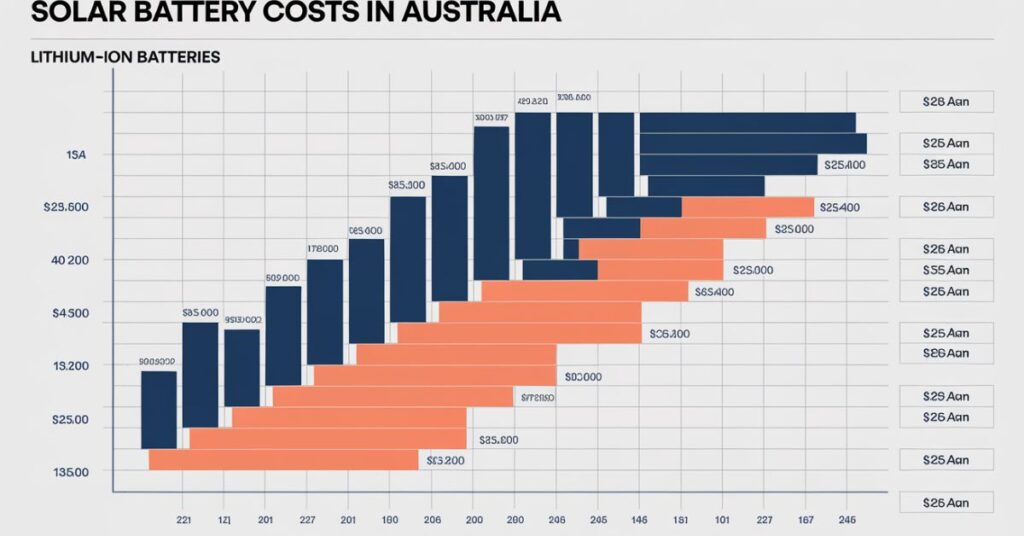
Quick answer: In Brisbane in 2026, a fully installed home battery costs $5,500–$15,000 after the federal Cheaper Home Batteries rebate, depending on usable capacity and brand. Budget tier (Fox-ESS, Anker SOLIX): ~$400–$500 per usable kWh installed. Mid tier (SigenStor, Sungrow): ~$550–$700. Premium (Tesla Powerwall 3, Enphase): $750–$900. The federal rebate knocks roughly 30% off — about $370 per kWh in 2026 — and tapers down to zero by 2030.
Two years ago we would not have recommended a battery to most Brisbane households. The maths simply did not work. In 2026 it does — but only for the right kind of household, on the right kind of tariff, with the right kind of equipment. Below is what batteries actually cost in Queensland this year, where the federal rebate stops and the small print starts, and how to tell whether a battery will pay for itself before its warranty expires.
2026 battery prices in Brisbane (post-rebate, installed)
These are real installed prices we are seeing on Brisbane quotes in 2026. Battery prices are pulled from the SolarQuotes May 2026 product list (post-rebate, GST-included, hardware only), then we have added a realistic install allowance of $1,800–$2,800 to reach the "out the door" figure.
| Battery | Usable kWh | Hardware (post-rebate) | Installed total | $/usable kWh |
|---|---|---|---|---|
| Fox-ESS CQ6 | 12 kWh | $3,900 | ~$5,900 | $490 |
| Anker SOLIX X1 | 15 kWh | $5,500–$6,500 | ~$7,800 | $520 |
| SigenStor 1-phase | 13 kWh | $6,300 | ~$8,500 | $650 |
| SigenStor 1-phase | 24 kWh | $10,000 | ~$12,500 | $520 |
| Sungrow SBR HV | 12.8 kWh | $8,100 | ~$10,300 | $800 |
| Sungrow SBH200 | 20 kWh | $11,700 | ~$14,300 | $715 |
| Tesla Powerwall 3 | 13.5 kWh | $10,500–$11,500 | ~$13,000–$14,000 | $960–$1,030 |
| BYD Battery-Box Premium | 10.2 kWh | $6,500 | ~$8,800 | $860 |
| Enphase IQ Battery 5P | 10 kWh (modular) | $8,800 | ~$11,000 | $1,100 |
Two things to flag before you go shopping on price alone. First, those installed totals assume you already have a compatible inverter or you are pairing the battery with new solar. A retrofit onto an old system without a hybrid inverter usually means adding a separate AC-coupled battery inverter ($1,500–$2,800). Second, $/kWh is a fair comparison metric, but it is not the only one — warranty depth, cycle life, blackout backup capability, and Brisbane heat performance all matter (see below).
The Cheaper Home Batteries Program, explained without spin
The federal Cheaper Home Batteries Program launched on 1 July 2025 as an expansion of the Small-scale Renewable Energy Scheme (SRES). The mechanics are identical to the panel STC rebate — your installer claims certificates on your behalf and applies the discount at point of sale.
- The rebate is roughly $370 per kWh of usable capacity in 2026 — about a 30% discount.
- Eligible batteries must be on the Clean Energy Council's approved list, between 5 kWh and 100 kWh in size, and installed by a CEC-accredited installer.
- You can only claim the rebate once per property.
- The certificate value drops by ~10% every January until it phases out completely in 2030.
- It stacks with state battery rebates (NT, WA, SA, NSW currently have them). Queensland does not have a state battery rebate in 2026 — federal only.
Practical implications for Brisbane households: a 13.5 kWh battery gets roughly $5,000 off in 2026, $4,500 off in 2027, $3,800 off in 2028. Waiting is not a winning strategy.
What size battery do you actually need?
Most installers will quote you 13.5 kWh because that is the size of a Tesla Powerwall 3 and they have one in the warehouse. That is not analysis — it is convenience. The right size depends on three things: how much you use after dark, how much your solar exports, and whether you want blackout backup.
- Small Brisbane household (1–2 people, $300/quarter bill, 4–5 kWh evening use): 10–13 kWh battery is plenty. Going bigger wastes capacity.
- Typical family (3–4 people, $500–$700/quarter, 7–10 kWh evening use, dishwasher + reverse-cycle AC after 5 pm): 13–17 kWh.
- Heavy evening / pool / EV household ($800+/quarter, EV charging, pool pump on overnight tariff): 20–27 kWh, often a stacked modular system like Sigenergy or Sungrow.
- Blackout backup priority (Logan and outer Brisbane storm zones): size for one full day of essential loads, typically 13–20 kWh, and make sure the installer wires a backup gateway. About a third of batteries sold without backup wiring cannot keep your lights on in an outage — check the spec.
Quick rule we use on Brisbane quotes: read your last 4 power bills, find the average daily kWh consumed between 4 pm and 9 am, and size to that. Anything more is being charged from the grid at off-peak or wasted.
Real Brisbane payback maths (2026)
This is the calculation that actually matters. We have run it for a real customer profile — 4-person Bardon family, 10 kW solar already on the roof, Energex Tariff 11, average $620/quarter bill before solar, $230/quarter after solar, evening-heavy load pattern. They are looking at adding a 13.5 kWh battery.
| Line item | Value |
|---|---|
| Battery hardware (Sungrow SBR 12.8 kWh) | $8,100 |
| Installation, switchboard, backup gateway | $2,400 |
| Total spend | $10,500 |
| Evening grid draw avoided: 8 kWh/day × $0.32 | $2.56/day |
| Lost feed-in revenue (was exporting 8 kWh at $0.05) | −$0.40/day |
| Net daily saving | $2.16 |
| Annual saving (350 effective days) | $756 |
| Simple payback | ~9.5 years |
| Battery warranty (Sungrow) | 10 years |
Pays back inside the warranty — just. That is a very different answer than two years ago. The number gets better if your retailer pays you less than 5c/kWh feed-in (which is increasingly common in QLD), if you also charge an EV at home, or if Brisbane's storm season costs you food in the freezer once every couple of years.
The number gets worse if you are on a legacy 8–11c/kWh feed-in tariff. In that case, every kWh stored is a kWh you no longer get paid 8c+ for. The export-credit-loss line in the table above doubles, and payback stretches past 12 years. Some of our long-time customers still on Origin/AGL legacy plans are better off keeping a smaller battery (or none) and exporting.
What separates a $500/kWh battery from a $1,000/kWh battery
You are paying for five things, in roughly this order of importance:
- Warranty terms. Tesla, Sungrow, Sigenergy, BYD, Enphase all warrant 10 years and ~60–70% retained capacity. Cheap unbranded LiFePO4 sometimes warrants 10 years on paper, but the local support entity is a shell company. Check who actually handles a claim in Brisbane.
- Cycle life. Quality LiFePO4 (which is now most of the market) delivers 6,000+ cycles to 70% capacity. That is 16+ years at one full cycle per day. Cheaper chemistry or poor BMS management cuts this in half.
- Heat performance. Brisbane summers regularly hit 38°C in the carport. Quality batteries are rated for continuous operation up to 50°C ambient with internal active cooling. Cheap units throttle hard above 35°C — meaning you bought 13 kWh but only get 9 kWh of useful storage on hot days.
- Backup capability. Not every battery offers blackout backup, and those that do often need a separate gateway ($800–$1,500). Tesla Powerwall 3 has backup built in. Sungrow needs an add-on SBK switching unit. Confirm what is included.
- Modularity. Sigenergy and Sungrow SBH stack from 13 kWh up to 40+ kWh. If you might add an EV in three years, buying a modular system now and expanding later is cheaper than replacing a fixed-size unit.
When a battery does not pay back in Brisbane
- You are out of the house all day and most evenings — your solar already exports almost everything. A battery just shifts the same export to grid draw.
- Your retailer pays you 8c+/kWh feed-in on a closed legacy plan. Every kWh stored displaces 8c of revenue plus the bill saving — the maths inverts.
- You are planning to move within 5 years. Batteries add roughly $3,000–$5,000 to sale price in Brisbane (less than they cost), so you wear the depreciation.
- You have less than 6 kW of solar. There is not enough generation to charge the battery and run daytime loads. Add more panels first.
What we would specify for a typical Brisbane home in 2026
For a 3–4 bedroom Brisbane house with 10 kW of existing solar, single-phase, $500+ quarterly bill, evening AC and dishwasher load, and storm-prone postcode:
- Battery: Sungrow SBR HV 12.8 kWh, or Sigenergy SigenStor single-phase 13–16 kWh (modular for future EV)
- Inverter: hybrid replacement if existing is a basic string unit (~$2,500 extra), or AC-coupled add-on if a quality hybrid is already on the wall
- Backup gateway: include it. Brisbane storm season earns its keep.
- Total spend after federal rebate: $9,500–$13,000 installed
- Expected payback: 8–10 years on Tariff 11 with low feed-in tariff
If your bill is below $400/quarter or you are still on a legacy feed-in tariff above 7c, the answer is often still "wait or skip". Honest is better than upsold.
Related guides
Get a free, no-obligation solar quote for your home or business.
CEC-accredited installers · Tier-1 panels · Australia's first written power-bill savings guarantee.
Keep reading
More from the Knowledge Centre

How Much Does Solar Panel Cleaning Cost?
Solar panel cleaning cost typically $100 to $300, depending on the size of the system and the complexity of the job. For a comprehensive understanding of why regular cleaning is crucial and how it…
Read article
How Much Does a Solar Hot Water System Cost in Brisbane? (2025 Guide)
Fully installed solar hot water systems in Brisbane cost $2,800–$5,800 after the federal STC rebate in 2025. Here's the honest breakdown — heat pump vs thermal, real payback maths, and the mistakes we see homeowners make.
Read article
Solar Panel Cost in Brisbane 2026: Per-Panel & Full System Prices
What one solar panel really costs in Australia in 2026 — plus fully installed 6.6 kW, 10 kW and premium system prices for Brisbane, the STC rebate maths, and three pricing traps to avoid.
Read article